The 5 Best AI Shopping Assistants for Ecommerce in 2026
AI shopping assistants answer product questions and guide shoppers to checkout on your store. We compare Shopify Inbox, Rep AI, Dialog, Gorgias and Insider One.
ChatGPT Ads opened to European advertisers at the end of August 2026: ads have been visible inside ChatGPT since 24 August, and the self-serve Ads Manager followed in early September. The channel is brand new, CPMs are low, competition is thin and almost nobody has any history. This is exactly the moment when early mistakes cost the least and good habits pay off the most. This guide gathers the best practices for launching and running a ChatGPT Ads campaign: how targeting really works, the console and its irreversible settings, the context-hints method, measurement, the rules, then what we observed on our own BotRank account. It draws on OpenAI’s documentation, on our tests and on the white paper published by the Lyon-based growth agency 1144, which you can download further down.
ChatGPT Ads is OpenAI’s advertising network. It displays a sponsored unit below ChatGPT’s answer, separated from the text, with the advertiser’s logo and name, an “Ad” label, a title, a description, a square image and a link. OpenAI tested the format in the United States from 9 February 2026, extended it to the UK, Mexico, Brazil, Japan and South Korea in August, then to 31 European markets including France on 24 August 2026. The self-serve Ads Manager, first reserved for agencies and partners, opened to European advertisers right after.
Three facts frame everything else. First, ads only reach the Free and Go plans. Plus, Pro, Business, Enterprise and Edu subscribers will never see them: the audience is massive (OpenAI announced 900 million weekly active users in February 2026) but capped by design. Second, OpenAI states that advertising does not influence ChatGPT’s answers and that sponsored results are clearly distinct from content. Third, in Europe targeting is purely contextual: the interface states that custom audiences are not available for campaigns targeting the EEA or Switzerland. No retargeting, no demographic segments, no use of the user’s history.
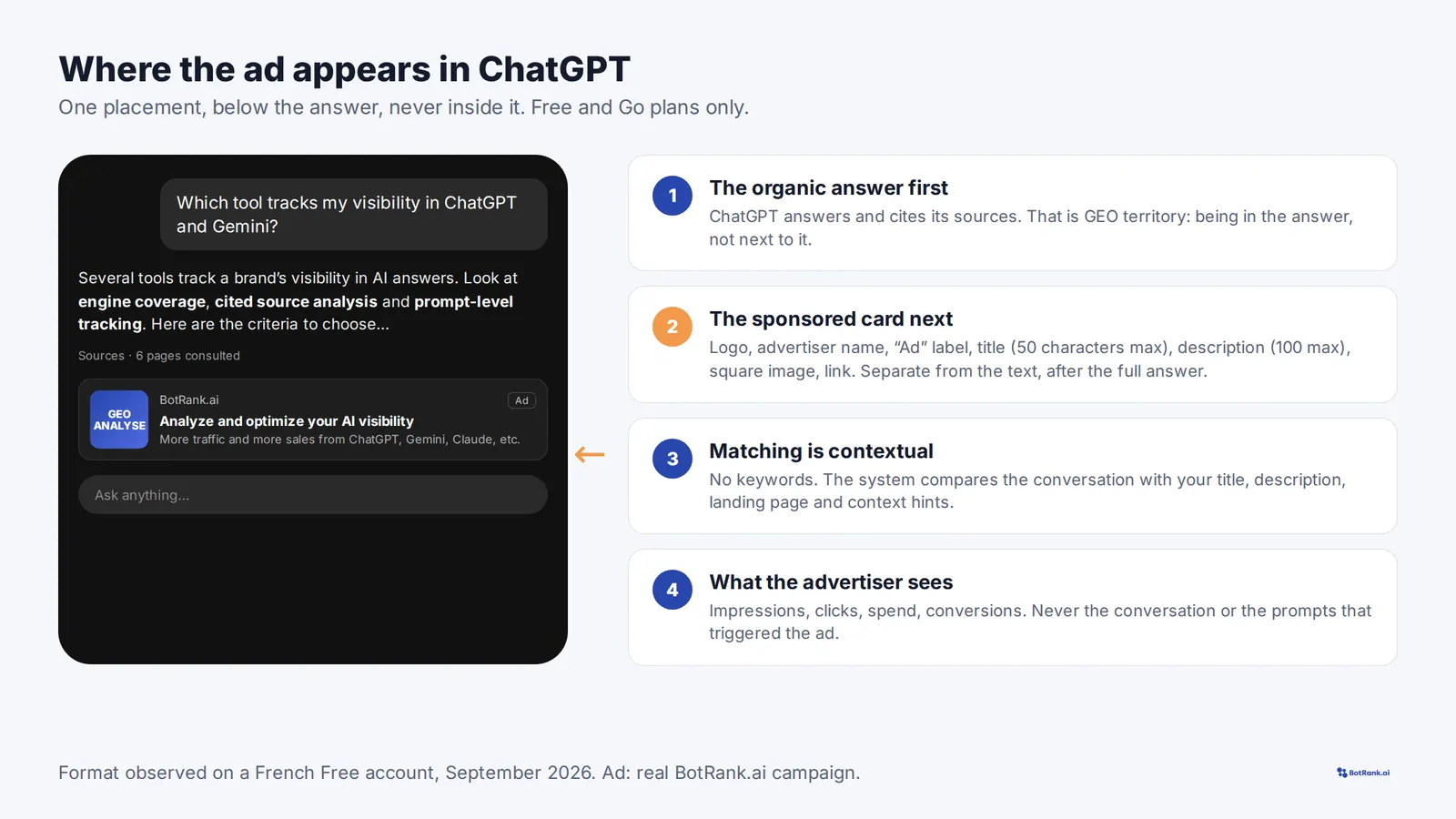
OpenAI’s developer documentation describes a relevance-weighted second-price auction. Four signals go into the calculation: the context and intent of the current conversation, the content of the landing page (hence the requirement to let the OAI-AdsBot crawler through), the ad’s title and text, then the context hints the advertiser provides at ad-group level. A fifth signal, drawn from the user’s ChatGPT experience, does not exist in the EEA or Switzerland.
The consequence matters: on three of the four signals, what you write is your targeting. Title, description, landing page and hints form one semantic set that the system compares with the conversation as it unfolds. Spinning an ad into ten cosmetic variants is not A/B testing, it is sending the same signal ten times.
The observed minimum daily budget is €15 per day, with no weekly cap on French accounts. Three objectives set the billing model: Reach (CPM), Clicks (CPC) and Conversions (oCPC, billed per click but optimized on conversion events). Two bidding strategies: “Maximize results”, selected by default, or a manual maximum CPC.
| Metric | Order of magnitude observed (French accounts, Sept. 2026) |
|---|---|
| Minimum daily budget | €15, no weekly cap |
| Average CPM | €9 to €12 |
| Average CPC | €0.60 to €1 |
| CTR | 1.2% to 1.4% |
These orders of magnitude come from two accounts tracked over time, in two different sectors (a GEO SaaS and a B2B acquisition agency): our own test, run over two weeks, and the one documented by agency 1144 in its white paper. We do not detail the total spend or the impression volume of these campaigns here: on such a young channel, those figures say more about each account’s strategy than the CPM and CTR already do about the price level. These are display impression costs, not search costs. They are low because competition is thin and brand inventory is almost empty. They will rise. The “$60 CPM, $200,000 minimum” rate cards that circulated in the spring appear nowhere in OpenAI’s documentation.
Opening the account takes three minutes and its simplicity is deceptive. The confirmation screen reads, under the create button: “These settings can’t be changed later, please configure carefully.” Country of establishment, billing currency and time zone are set for life. For a French advertiser: France, EUR, Paris. Check them three times, it is the best effort-to-benefit ratio of the whole journey. Two prerequisites then block delivery until they are done: billing configured and company logo uploaded. Handle them at sign-up, not on launch day.
The hierarchy is classic: campaign, ad group, ad. At campaign level you choose the type (Standard, where you write the ads, or Product feed, where they are generated from your catalog in Google Shopping format), the objective, targeted and excluded locations (exclusion wins), eligible platforms (iOS, Android, Web, all checked by default) and the budget. Two traps 1144 documented on its own account: a campaign created in CPM or CPC cannot be converted to oCPC afterwards. A campaign’s total budget can no longer be edited once delivery has started. For a first launch with no conversion history, go with the Clicks objective, the “Maximize results” bid and a daily budget.
The “Context hints” field sits at ad-group level. The interface presents it as optional. It is not. On a channel with no keywords, no negatives and no search-terms report, it is the only place where you explicitly tell the system what you are aiming at. An ad group launched with that field empty is the equivalent of a broad-match search account with no negatives and no reporting: the system alone decides where you show up.
The definition shown in the console says it all: “Describe the conversations, topics, or keywords where your products or services may be relevant; these hints guide matching but aren’t exact-match targeting rules.” You describe conversations, not audiences. OpenAI recommends describing needs and situations rather than audience labels. “HR software, HRIS, payroll” is a keyword list in disguise. “A 30-to-200-employee company that still manages leave requests in a spreadsheet and loses time every month-end” is a situation the model can match to a real conversation.
The protocol 1144 published, with its full production corpus, fits in four blocks per ad group.
| Block | Content | What it brings to matching |
|---|---|---|
| 1. The framing | One sentence stating which conversations you target and which you do not. | Negation (“to generate leads, not e-commerce sales”) is the channel’s only pseudo-negative. |
| 2. Typical topics | Real questions, in quotes, written the way the user types them, in the first person. | Each question is a target conversation. This is the heart of the corpus. |
| 3. Vocabulary | Trade terms: tool names, metrics, jargon. | The semantic footprint of your territory: if these words come up in a conversation, it is yours. |
| 4. People and their questions | Who is writing, in what situation, with which underlying questions. | A context description, not demographic targeting. |
1144’s corpus for its B2B Meta Ads group runs 1,558 characters, thirteen target conversations written verbatim and twenty-four vocabulary terms, in a single field. Start from your prospects’ real questions, the ones from sales calls, support tickets, contact forms. Rephrase them the way people would type them into ChatGPT. If you already track your prompts in a GEO tool, you already have this material: the buying prompts in your Prompt Studio are, word for word, the typical topics of your context hints. One theme per ad group, one tight corpus per theme. If you hesitate about putting two offers in the same group, they do not belong together.
The title accepts 50 characters, the description 100. The truncation warning appears early, from 25 characters on the title. The practical recommendations: 16 to 24 characters for the title, 32 to 48 for the description, because the actual display area is narrow, especially on mobile. The image is square, PNG or JPG, 256 × 256 px minimum. OpenAI explicitly recommends showing the product or its use rather than the logo alone. The preview in the ad editor is the only screen that renders the unit as the user will see it: if the title is truncated there, it will be in production.
The underlying reason for these constraints is matching. In September 2026 it is still approximate. SE Ranking measured in August, on 50,006 commercial prompts in the United States, that 14.35% of ads had no topical link with the query. Seer Interactive observes, on its own queries, that the share of ads merely “adjacent” to the category went from 28% to 58% in six weeks: the system is widening faster than it is sharpening. Your ad will therefore also appear in front of people who were not talking about your topic. A title that only makes sense in the right context loses those impressions. A short question that works out of context (“Are your ads plateauing?”, “Is Meta giving you nothing?”) performs even outside an advertising conversation.
Over the full course of our test, the generalist ad “Analyze and Optimize your AI Visibility” (the French original runs 41 characters with a 69-character description) kept a CTR lead over the more specialized “Comparison” variant, even as the gap narrowed over the days. The signal points toward generalist, out-of-context-friendly creatives on a channel still close to display.
Your landing pages must not block OAI-AdsBot. It is an eligibility condition: the crawler validates and re-reads your destination pages. OpenAI also recommends allowing OAI-SearchBot. Check robots.txt, but also the CDN, the WAF and anti-bot systems, which often block without any explicit error message. It is the most frequent silent cause of failure. The topic is the same as for organic visibility: we explain why robots.txt is not enough for ChatGPT.
Three building blocks. The OpenAI Pixel, a JavaScript tag: the click appends an oppref identifier to the URL, which the pixel stores in a first-party cookie. The Conversions API, a server-side send with the same oppref, to be deduplicated by event ID if you also use the pixel. URL parameters, automatically appended to links with the values {campaign_id}, {ad_group_id}, {ad_id}, {ad_account_id} and {oppref}, to combine with your UTMs so you can read this traffic in your analytics. For a European advertiser, the pixel sets a first-party cookie: make its firing conditional on your consent management platform.
The order that avoids regrets: pixel installed and verified, conversion event created (one per campaign, not editable afterwards), end-to-end test, then launch. Conversion tracking is wired before the first euro, because conversion history is what will unlock oCPC later.
The Ads Manager shows impressions, clicks, spend, CTR, average CPC, average CPM and conversions, with a post-click latency of 24 to 48 hours. It shows no search-terms report, no demographic breakdown, no user-level data. You will never know which conversations you appeared in. Without a query report, the only way to learn is to structure your ad groups as testable hypotheses: each group answers a question whose performance gap will provide the answer. On 1144’s campaign, one thematic group pulled clearly ahead of the account average, on a still-small volume: a signal, not a conclusion.
A ChatGPT ad shows below the answer, to Free and Go users, as long as the budget runs. It changes nothing about what ChatGPT says about you inside the answer itself, to every user, including the Plus, Pro and Business subscribers who will never see an ad. That second layer is GEO: being cited, mentioned or recommended in the answer, based on your pages, your third-party sources and the consistency of your brand. The two levers add up, they do not substitute for each other. The eight fixes to rank in ChatGPT Search and the full method for making a brand visible in ChatGPT remain valid, ads or no ads. For e-commerce, the product lever runs through the feed and the carousel, detailed in how to get your products into ChatGPT Shopping.
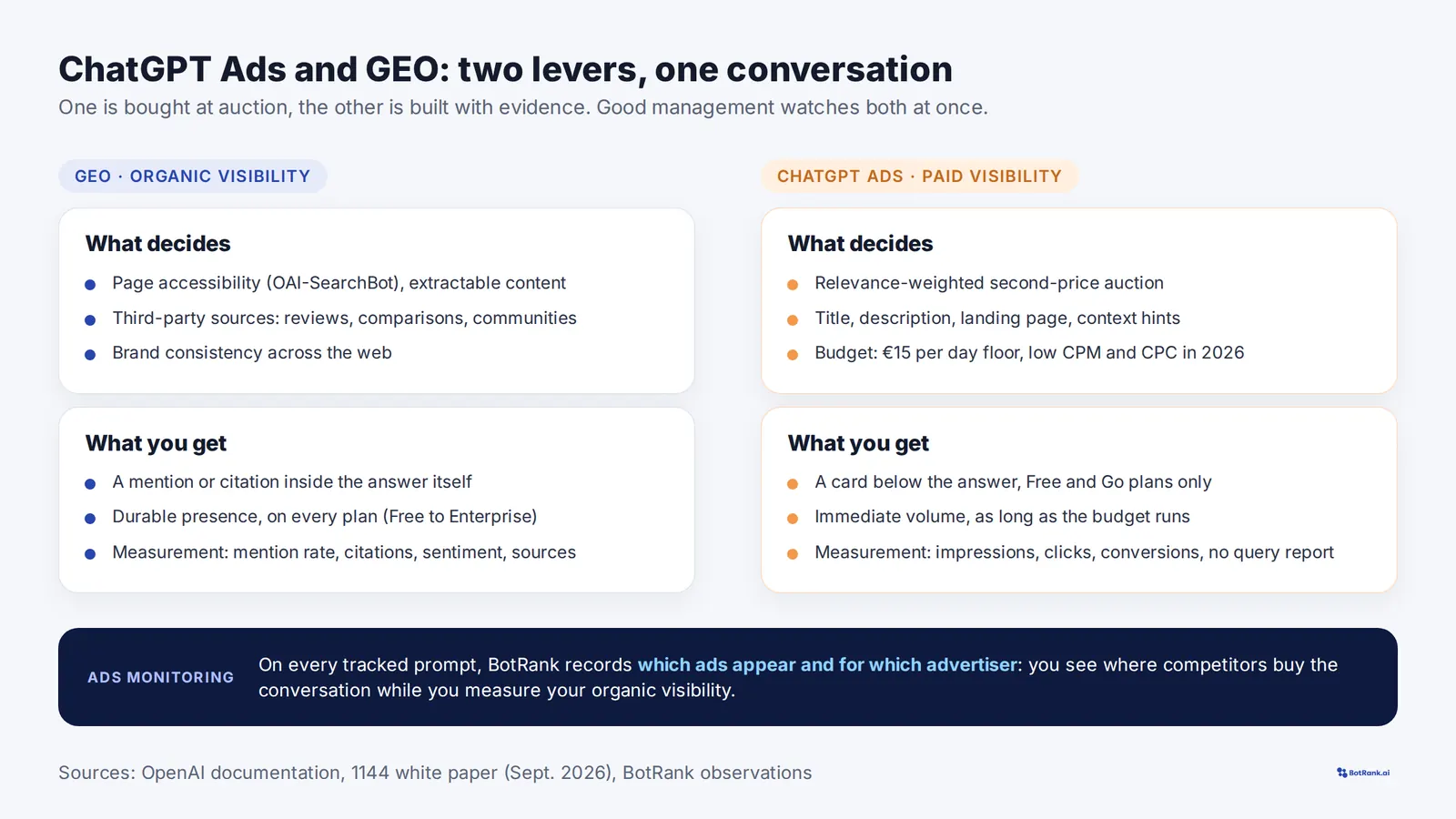
There is an awkward asymmetry in ChatGPT Ads: the advertiser does not know which conversations it appears in. Nobody knows who is buying the conversations in their category. That is why BotRank integrates Ads Monitoring into its visibility tracking. On every prompt you track, BotRank records whether an ad shows below the answer, for which advertiser, with which title and which landing page. Prompt by prompt, you get the full picture: who is cited in the answer, who is recommended, then who bought the slot underneath. A competitor systematically buying your comparison prompts, or a category where nobody advertises yet, shows up at a glance. Ads Monitoring sits alongside visibility analysis and source analysis, in the same prompt panel.
OpenAI’s policies, updated at the end of August 2026, prohibit twelve sectors with no exemption: adult content and dating, alcohol and tobacco, counterfeits and scams, gambling, sexual or violent content, individual housing and job listings, legal services (outside the United States), political content, recreational drugs, exploitation of tragedies, unsubstantiated wellness claims. Two sectors are restricted: financial services and health, approved case by case and, to date, generally prohibited outside the United States. A European advertiser in finance, insurance or health has no documented path in.
Whatever your sector, no ad is served in about fifteen contexts decided by OpenAI: health and mental health, vulnerability, emotional dependence, child safety, politics, violence, misinformation, temporary chats, minor accounts, among others. The creative requirements fit in one line each: truthful claims, professional language, accurate company identity, consistency between ad and landing page, creatives “clearly distinguishable from the ChatGPT product experience”. The blind spot you have to accept: you do not know the conversation you appear in and you have no exclusion tool. Your brand safety rests on OpenAI’s classifiers.
The Lyon-based growth agency 1144 opened its account on the day the French market opened and documented the whole journey: the console screen by screen, its context-hints corpus published in full, its first campaign with open books and a 20-point checklist. Rare field work on such a young channel, which we make available here in one click.
ChatGPT Ads today looks like cheap contextual display laid over the most attentive audience on the web. The real stake is not the CPC, it is what the network does not show: the conversations. An advertiser who writes context hints from real prompts, structures ad groups as hypotheses and tracks in parallel what ChatGPT answers organically on those same prompts learns twice as fast as one who only watches the Ads Manager. Matching will sharpen, CPMs will rise. Those who have built up history and learnings during the display period will be best placed when precision arrives.
Create an advertiser account on ads.openai.com, set up billing and the logo, then create a campaign (objective, locations, platforms, budget), an ad group (bid, destination URL, context hints) and an ad (title, description, image, link). The minimum budget is €15 per day. Your landing pages must allow OAI-AdsBot.
Only logged-in adult users on the Free and Go plans. Plus, Pro, Business, Enterprise and Edu subscribers see no ads, according to OpenAI.
No. There are no keywords, no negatives and no search-terms report. Targeting is contextual and relies on the title, the description, the landing page and the ad group’s context hints. In Europe, custom audiences and retargeting are not available.
The floor is €15 per day. On the first French accounts observed in September 2026, CPM sits between €9 and €12, CPC under €1 and CTR between 1.2% and 1.4%. These are channel-launch levels, and they will rise with competition.
No. OpenAI states that advertising does not influence answers and that ads are clearly distinct from content. To be present in the answer itself, you have to work on organic visibility, that is GEO.
The Ads Manager does not show it. Prompt tracking that records the ads displayed below answers, such as Ads Monitoring in BotRank, lets you see which advertisers occupy the sponsored slot on each tracked conversation.

After nearly 15 years in digital strategy on the client side (including 10 years at Olympique Lyonnais, where he was notably in charge of SEO).
Florian co-founded BotRank.ai in 2025, the GEO (Generative Engine Optimization) tool used by more than 2,500 companies to manage their visibility in AI-generated search results. He writes regularly about GEO and AI Search.