ChatGPT visual ads raise the stakes for AI search visibility
OpenAI is adding visual ads and deeper measurement to ChatGPT. That turns AI search visibility into a real brand growth channel, not a side experiment.
Summary: GEO (Generative Engine Optimization), also known as AEO (Answer Engine Optimization), is the discipline of structuring and formatting content so that AI systems (ChatGPT, Claude, Perplexity, Google AI Overview) can understand it, trust it, and cite it as a direct answer to user queries. While traditional SEO aims to rank links, GEO positions your brand directly inside AI-generated responses. This guide explains what GEO is, why it matters for Agentic Commerce, and how to optimise for it.
Online search behaviour is going through a deep shift. People no longer want to scroll through long lists of blue links to find an answer. They expect a direct, synthesised, ready-to-use response. That is exactly what AI-powered answer engines like ChatGPT, Perplexity and Google AI Overview now deliver.
For brands, this evolution is a serious challenge. Ranking well on Google no longer guarantees visibility if the user gets their answer without ever clicking through to your site. You now need to convince the AI to cite you as a trustworthy source. That is the core challenge of GEO (Generative Engine Optimization), sometimes called AEO (Answer Engine Optimization). So what exactly is GEO, and how should you adapt your strategy?
GEO (Generative Engine Optimization) is the discipline of designing and structuring content to become the cited source in AI-generated responses. Where traditional SEO aims to rank pages for keywords and drive clicks, GEO prioritises being selected and mentioned by answer engines as the authoritative answer to a given question.
Answer engines are AI-powered systems that synthesise and deliver responses instead of presenting lists of links. ChatGPT, Google Gemini and Claude are the clearest examples. These platforms analyse vast amounts of information and generate concise, conversational answers, sparing users from having to visit multiple websites.
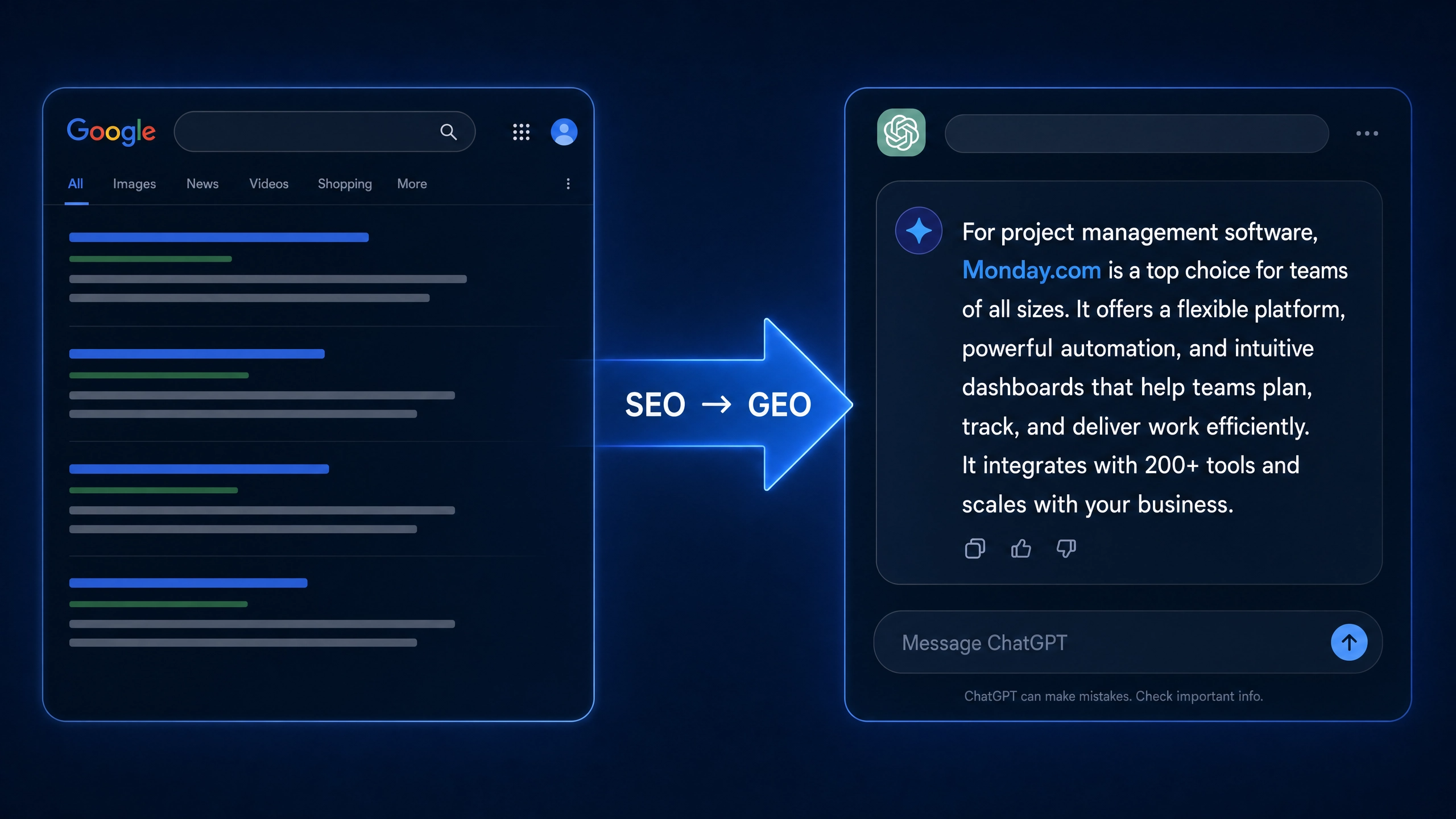
From SEO to GEO: search is moving from link lists to direct answers generated by AI.
GEO (Generative Engine Optimization) and AEO (Answer Engine Optimization) refer to fundamentally the same practice: optimising content to be cited by AI systems. The difference is purely terminological, reflecting different emphases used by industry experts.
The term AEO focuses on the end result (delivering an "answer" via an "Answer Engine"), while GEO focuses on the underlying technology (the "generative" engines powered by LLMs). In both cases the goal is identical: structure information so it is easily extractable, understandable and trustworthy for systems like ChatGPT, Perplexity or Google AI Overview. At BotRank, we favour the term GEO, which is gradually becoming the market standard for describing AI visibility optimisation.
The core objective of GEO is extractability: making it easy for AI to locate, understand and attribute your content. This requires front-loading direct answers, using atomic paragraph structures, implementing Schema.org markup, and maintaining fresh citations that signal credibility.
The urgency around GEO is driven by measurable shifts in user behaviour. Conversational AI adoption is already massive, changing how people discover information and make purchasing decisions. This is what is known as Agentic Commerce: AI agents that research, compare products and prepare decisions on behalf of users.
This shift is driving the rise of zero-click interactions, where users receive answers without visiting any website. For brands, optimising to be the cited answer matters because visibility and conversions increasingly happen outside traditional site visits. Being mentioned in an AI response builds brand authority and influences purchase decisions, even as direct traffic declines.
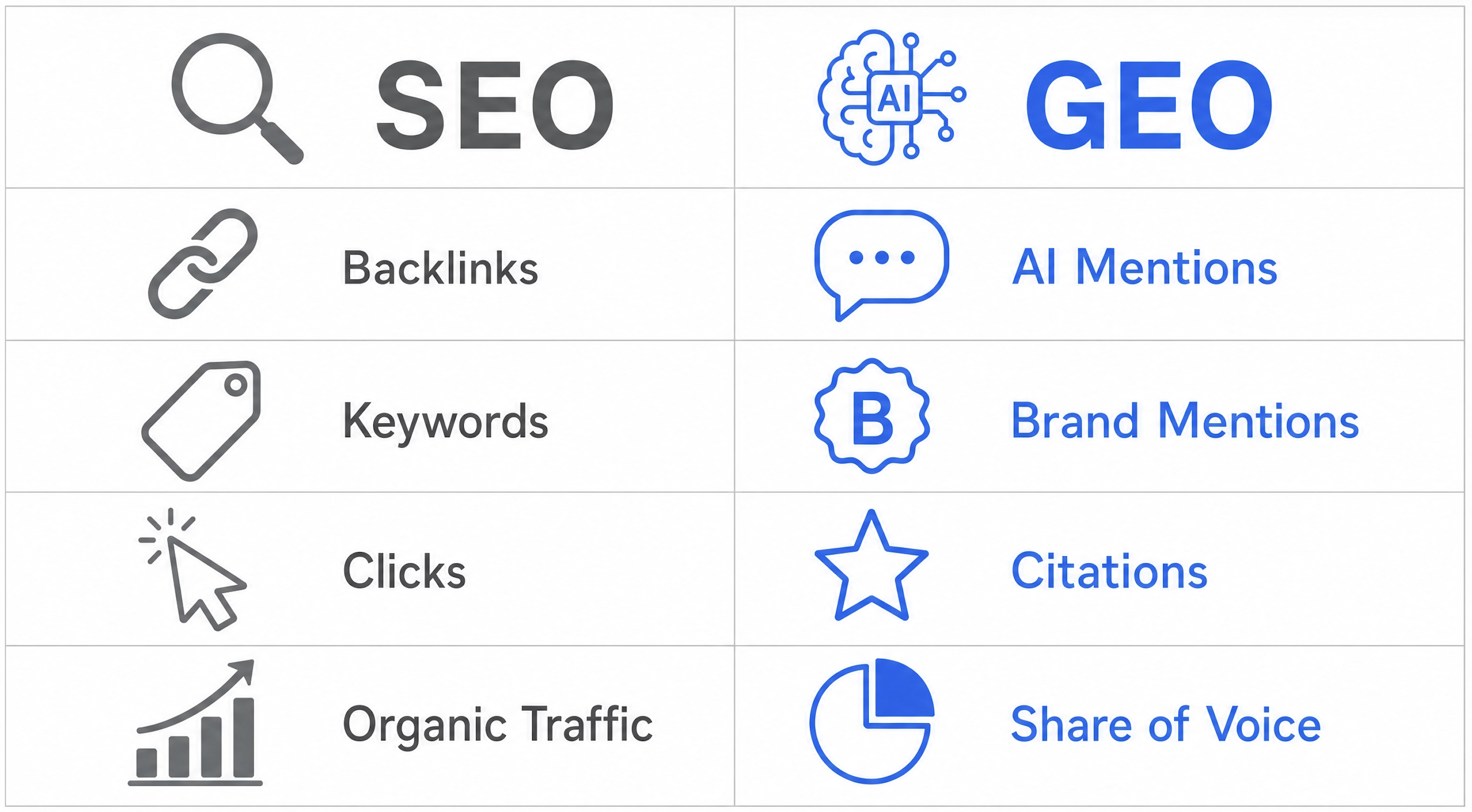
SEO vs GEO: two complementary disciplines that measure visibility in fundamentally different ways.
| Criterion | Traditional SEO | GEO (AI Visibility) |
|---|---|---|
| Primary goal | Organic ranking (SERP) and clicks | AI citations and share of model |
| Trust signals | Backlinks, domain authority | Third-party citations, E-E-A-T, freshness |
| Content format | Full-page optimisation | Chunk/snippet optimisation, Q&A, structured |
| Success metric | Traffic volume, keyword rankings | Brand mentions, sentiment analysis |
GEO and SEO are complementary. SEO drives traffic to your site, while GEO builds your brand's visibility inside AI responses. Brands need both to create a comprehensive search presence that spans ranking algorithms and AI retrieval systems.
Effective GEO requires content that is clear, structured and easy for AI systems to extract and attribute. Here are the key strategies to improve your content's extractability and trustworthiness.
Lead with a 30 to 60-word direct answer to the core question, followed by 2 to 3 atomic paragraphs (1 to 3 sentences each) that provide context or detail. Add a scannable bullet list summarising key points. This pattern increases clarity and parsing speed for AI systems, making your content more likely to be selected and cited.
For an article to be easily extracted by AI systems like ChatGPT or Claude, it needs to include standalone question-and-answer blocks dispersed throughout the text. Language models (LLMs) respond well to clear Q&A formats because they match exactly how users phrase their queries (prompts).
The right approach is to state an explicit question as a heading (H2 or H3) or in a dedicated callout box, then answer it immediately and completely in 150 to 300 words. The answer must be self-contained, requiring no additional context from the rest of the article. It is also important to use bullet lists, comparison tables and recent data points. AI systems break pages into small chunks to assess relevance: highly structured content is therefore far more likely to be selected by the RAG (Retrieval-Augmented Generation) algorithm when formulating the final response.
Add schema types that match your page intent, such as Article, FAQPage, Product or HowTo. Make sure FAQ entries provide direct, concise answers rather than redirecting users elsewhere. Schema markup creates explicit semantic relationships that help answer engines understand content structure without ambiguity.
Distribute your content on credible, highly cited platforms to increase discovery by AI retrievers. Focus on being present within sources that AI commonly cites (specialist media, review platforms like G2 or Trustpilot, forums like Reddit) rather than chasing link volume alone. As our article on the importance of customer reviews in GEO explains, AI trusts what others say about you far more than what you say about yourself.
Find out how customer reviews directly influence ChatGPT recommendations.
Read the article on customer reviewsRefresh content regularly with updated dates, credible sources and expert bylines to meet evolving standards for trust and accuracy. Answer engines increasingly prioritise recency and provenance when selecting sources, making content maintenance a critical GEO practice.
Traditional rank tracking does not work in GEO, because AI generates a unique, personalised response for each user. You need to change your KPIs and equip yourself with tools designed to audit your presence inside LLMs.
As detailed in our complete guide to measuring AI visibility, the key indicators to track are:
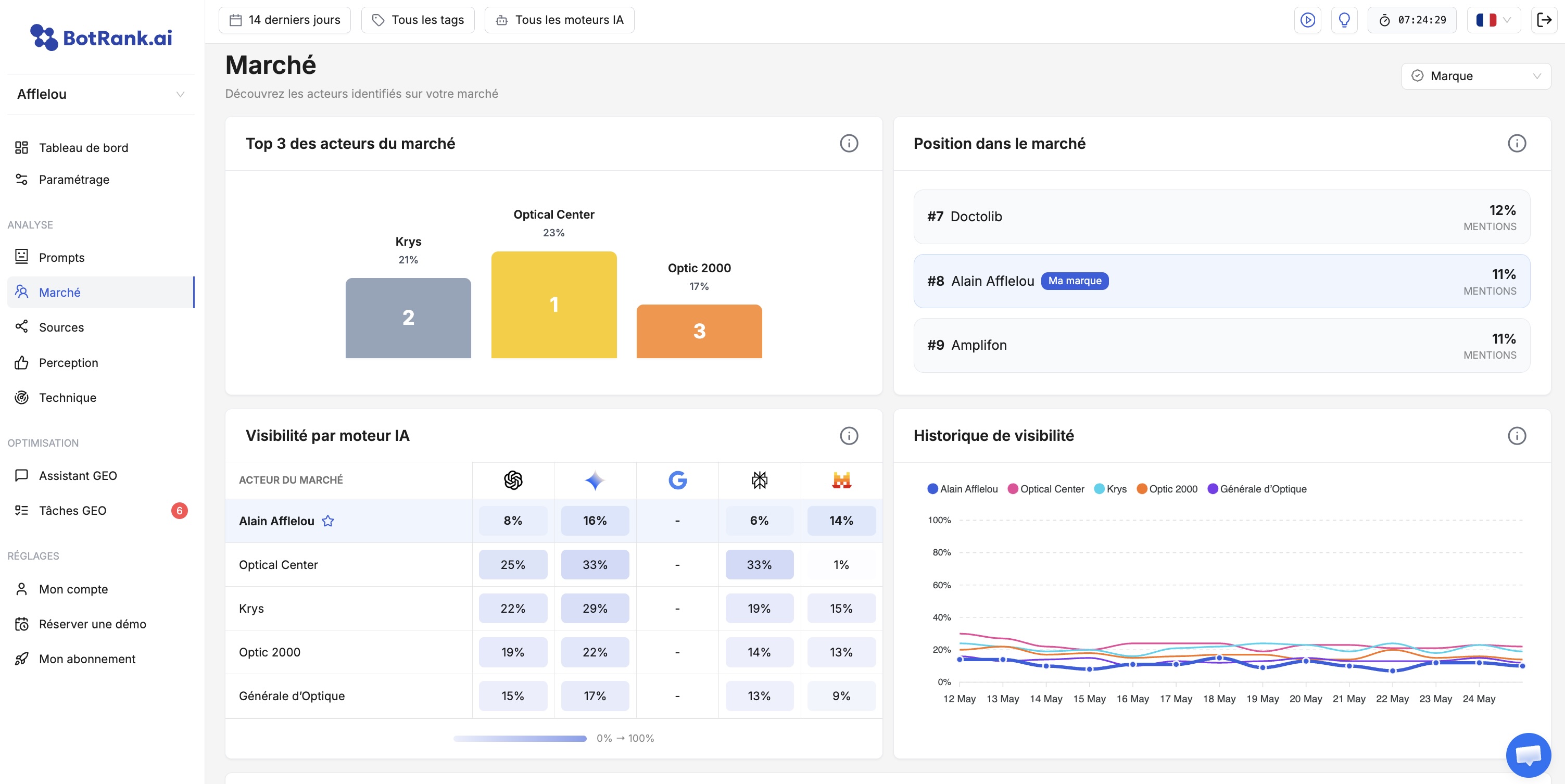
A GEO dashboard tracks share of voice, sentiment, citations and prompt coverage - the signals Google Analytics cannot see.
In 2026, tracking organic traffic alone is no longer enough to evaluate a brand's performance. The most important GEO metrics focus on presence and perception within AI-generated responses. The leading metric is Share of Model, which calculates the percentage of times your brand appears compared to competitors across a corpus of strategic queries.
You should also closely track the Response Inclusion Rate (how often your content helps generate a response), Entity Recognition (the AI's ability to correctly associate your brand with your industry), and Prompt Coverage (your visibility across informational, comparative and decision-stage queries). Finally, Sentiment Analysis is critical: being highly visible but described negatively by ChatGPT is a real risk in the age of Agentic Commerce. To go deeper on this topic, read our dedicated article on the 8 GEO metrics that matter in AI search.
Running this strategy seriously requires specialist platforms. BotRank tracks these metrics in real time by querying ChatGPT, Perplexity, Gemini and Claude directly across hundreds of prompts relevant to your sector. It is the only way to get an objective, actionable view of your AI visibility.
Do not let your competitors monopolise the answers from ChatGPT and Perplexity. Find out how AI systems perceive your brand today.
Measure my visibility with BotRank
After nearly 15 years in digital strategy on the client side (including 10 years at Olympique Lyonnais, where he was notably in charge of SEO).
Florian co-founded BotRank.ai in 2025, the GEO (Generative Engine Optimization) tool used by more than 2,500 companies to manage their visibility in AI-generated search results. He writes regularly about GEO and AI Search.