AI local search is breaking the old discovery funnel
AI is now a mainstream way to find local businesses, but consumers rarely trust it alone. Brands win when answers, reviews, search, and social stay...
In a nutshell: Generative Engine Optimization (GEO) is the strategy that gets your brand cited and recommended by AI systems like ChatGPT, Perplexity, and Google AI Overviews. Unlike SEO, which targets link rankings, GEO targets inclusion in the generated answer itself. This guide covers the 10 best practices for optimising your content in 2026: clear structure, entity optimisation, autonomous Q&A blocks, and strong trust signals. The goal: become the go-to source that language models choose to cite.
Online search is going through its biggest revolution since Google was created. Users no longer want to scroll through ten blue links to find an answer; they want a direct, synthesised, ready-to-use response. That is exactly what generative engines provide (ChatGPT, Perplexity, Gemini, Claude).
For brands, the challenge is enormous. Ranking first on Google no longer guarantees visibility. You now need to convince artificial intelligence to cite you as a reliable source. That is the whole point of GEO (Generative Engine Optimization). But how do you go about it in practice? Here is the complete guide and the 10 best practices to succeed with your GEO strategy in 2026.
This guide focuses on writing. To build your GEO strategy step by step (technical, content, external authority), see our dedicated guide.
Before diving into optimisation techniques, let us align on the key terms that define this new discipline.
It is tempting to see GEO as a simple evolution of SEO. That would be a mistake. Both disciplines share common foundations (content quality, technical authority), but their objectives and methods diverge significantly.
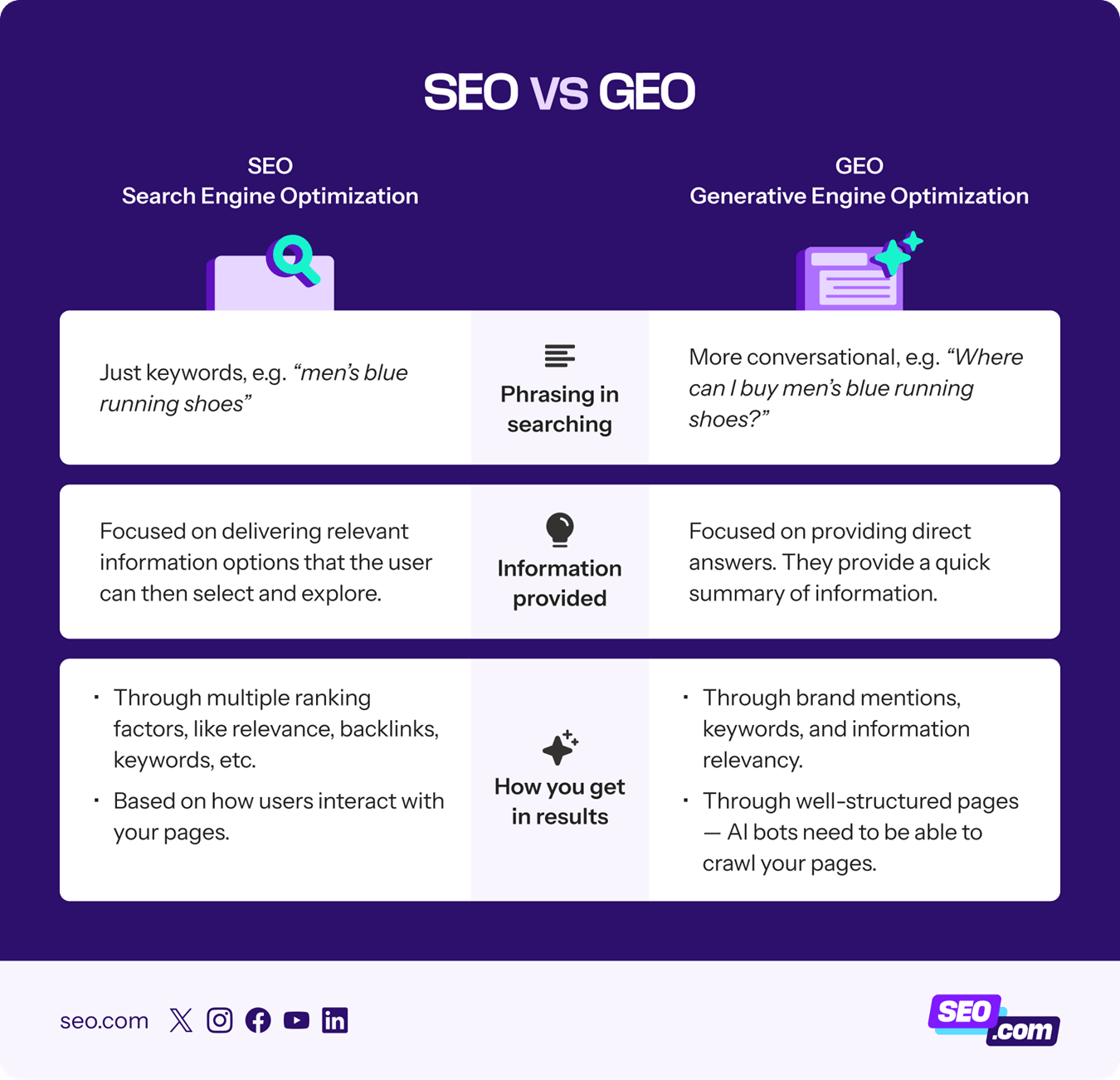
The main difference lies in the final objective and the output format. SEO (Search Engine Optimization) aims to rank a web page as high as possible in a list of results (Google's blue links) in order to generate a click. GEO (Generative Engine Optimization) aims to ensure that your brand, data, or expertise are directly integrated and cited in the text response generated by an AI (such as ChatGPT or Perplexity).
In practice, SEO optimises for short keywords and a ranking algorithm, while GEO optimises for long conversational questions and a language model that synthesises information. Excellent SEO does not guarantee good GEO visibility, because AI systems often favour third-party sources (media outlets, forums, comparison sites) over the brand's own website.
A generative engine user is not looking for a website to visit; they are looking for an immediate answer. Your job is no longer to attract the visitor, but to provide the best raw material for the AI to build its response around you.
How do you concretely optimise your content for generative engines? Here are the 10 strategies that work today, based on analysis of AI crawler behaviour and RAG algorithms.
AI systems do not read like humans. They break your pages into small chunks to assess relevance. If your answer is buried inside a 500-word paragraph, the AI will miss it. Use a strict H2/H3 hierarchy. Start each section with the direct answer, then expand on the context. Bullet lists, tables, and numbered steps increase the chances of being extracted by a RAG model by 30 to 40%.
This is GEO's best-kept secret. LLMs love clear Q&A formats. Scatter autonomous questions throughout your articles, each followed by a complete answer (between 150 and 300 words). The question should reflect the user's intent, and the answer must stand on its own without requiring the reader to consume the rest of the article.
For content to be easily read and cited by an AI, it must be structured as autonomous, highly readable information blocks. The golden rule is the inverted pyramid: give the direct, concise answer in the very first sentence of the paragraph, then elaborate on the context afterwards.
Use a very descriptive heading hierarchy (H2, H3) that either poses a clear question or precisely announces the topic covered. Language models (LLMs) strongly favour structured formats: use bullet lists, comparison tables, numbered steps, and FAQ sections liberally. Finally, avoid unnecessary jargon and overly long sentences. A paragraph of 2 to 3 sentences maximum, focused on a single strong idea, is far more likely to be extracted by the AI's RAG (Retrieval-Augmented Generation) system when formulating its response.
AI does not understand keywords; it understands entities (concepts, brands, people) and the relationships between them. Make sure your brand is clearly defined across all your pages. Create a comprehensive "About" page. Consistently link your brand to your industry in a repeated, coherent way. The goal is for your brand to be inseparable from your product category in the AI's internal knowledge graph.
Schema.org markup is not new, but it is vital for GEO. It acts as a direct translator for AI. Systematically implement the Article, Organization, FAQPage, and HowTo schemas. This allows AI crawlers to instantly understand the nature of your content without having to laboriously interpret it.
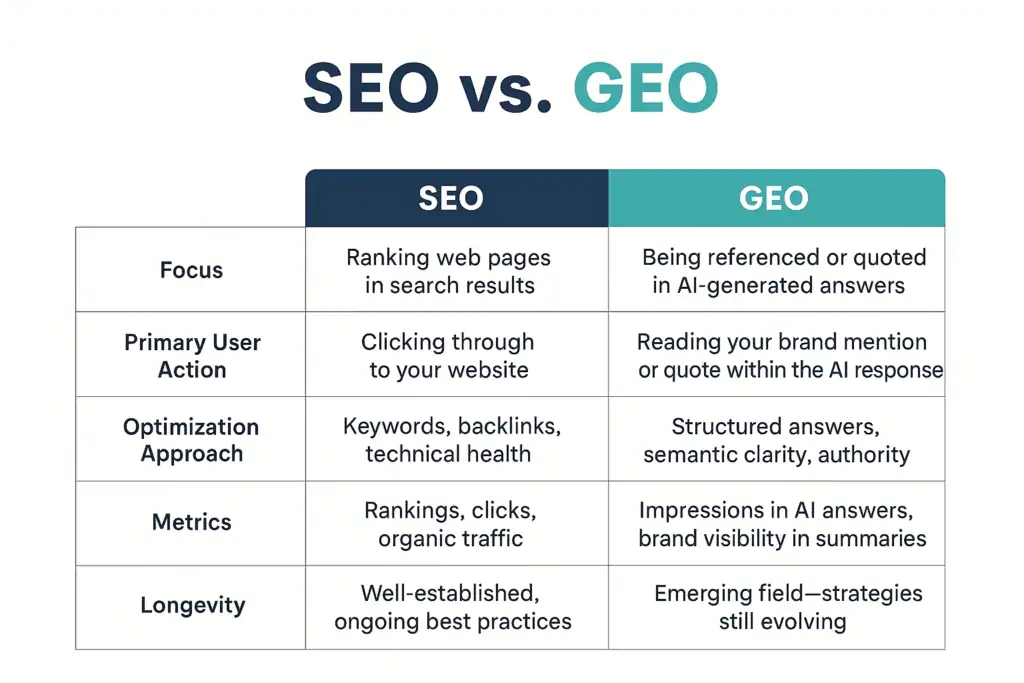
When a user asks Perplexity a complex question, the AI breaks it down into 3 or 4 shorter sub-queries to search for information. This is known as "query fan-out". Do not only target the user's long question: make sure your content clearly answers the specific sub-queries that the AI will generate in the background.
This is the tipping point of GEO. Studies show that AI systems trust third-party sources (media outlets, comparison sites, Reddit, forums) far more than the brand's own website. If you say you are the best, the AI is sceptical. If G2, Trustpilot, and three specialist blogs say it, the AI cites you. Your PR strategy and presence on comparison platforms are the foundation of your GEO authority.
Press relations and customer reviews are crucial for GEO because AI systems (LLMs) are built to seek consensus and reliability through independent third-party sources. When an AI needs to recommend a product or service, it assigns much less weight to claims made on the brand's official website (viewed as biased or promotional).
Instead, it scans the web for mentions on authoritative sites: press articles, independent comparison platforms (such as G2 or Capterra), discussion forums (such as Reddit), and review platforms (Trustpilot). If your brand is regularly cited positively on these external platforms, the AI will consider your expertise validated by the broader ecosystem. In GEO, what others say about you is infinitely more important than what you say about yourself. External validation is what triggers citation by the AI.
Want to know what ChatGPT and Perplexity are saying about your brand right now?
Try BotRank for freeAI systems look to source their claims. Make it easy for them. Do not say "most companies do X". Say "According to study Y from 2026, 74% of companies do X". Include citations from identified experts with their name and title. AI loves extracting these factual elements to lend weight to its own responses.
Generative engines favour the most recent information. An excellent article from 2024 will often be overlooked in favour of an average article from 2026. Update your pillar content regularly. Add the last-updated date visibly at the top of the page. The AI needs to know your data is current.
All this work is pointless if AI crawlers cannot read your site. Check your robots.txt file to make sure you are not accidentally blocking GPTBot, ClaudeBot, or PerplexityBot. Also watch out for firewalls (like Cloudflare) that sometimes block AI bots by default. Finally, avoid content rendered purely via client-side JavaScript, which many AI bots cannot parse.
To verify that AI bots can crawl your site, start by inspecting your robots.txt file (accessible at yoursite.com/robots.txt). Make sure no rule blocks the following user-agents: GPTBot (OpenAI/ChatGPT), ClaudeBot (Anthropic), PerplexityBot (Perplexity), and Google-Extended (Google AI Overviews).
Next, if you use Cloudflare as a CDN or firewall, check the "Bots" section in the dashboard: Cloudflare has enabled AI bot blocking by default on many accounts since 2024. Enable the "AI Crawl Metrics" option to see which bots are attempting to access your site. Finally, analyse your server logs for AI bot user-agents and confirm they are receiving an HTTP 200 (success) response rather than a 403 (access denied) or 429 (too many requests). A site that is inaccessible to AI bots is invisible in generated responses, regardless of the quality of its content.
This is the major technical development of 2026. Similar to robots.txt, the llms.txt file (placed at the root of your site) allows you to guide language models specifically. It provides a clear summary of your site and brand, and points AI systems to where the most important and structured information can be found. It is a strong signal that your site is "AI-friendly".
Classic rank tracking does not work in GEO. AI generates a unique response for each user. You need to change your KPIs and equip yourself with the right tools.
The metrics to track are:
Platforms like BotRank allow you to track these metrics in real time, by directly querying ChatGPT, Perplexity, Gemini, and Claude across hundreds of prompts related to your industry. It is the only way to get an objective view of your AI visibility.
Do not let your competitors monopolise ChatGPT and Perplexity responses. Find out how AI systems perceive your brand today.
Measure my visibility with BotRank
After nearly 15 years in digital strategy on the client side (including 10 years at Olympique Lyonnais, where he was notably in charge of SEO).
Florian co-founded BotRank.ai in 2025, the GEO (Generative Engine Optimization) tool used by more than 2,500 companies to manage their visibility in AI-generated search results. He writes regularly about GEO and AI Search.