
GEO & SEO: The Best Complete Guide 2026

Published:
June 7, 2026

Key takeaway: GEO (Generative Engine Optimization) and SEO (Search Engine Optimization) are not in competition - they complement each other. In 2026, a complete visibility strategy means combining the domain authority and backlinks of SEO with the data structuring and third-party reputation management of GEO. The goal is to rank well on Google while being cited as the best solution by ChatGPT, Perplexity and Gemini.

If you are reading this article, you are probably trying to understand how to adapt your search strategy to the age of artificial intelligence. You are right to do so: the online search landscape has changed more in the past two years than in the entire previous decade. Users no longer just type keywords into Google to get a list of blue links. They ask complex questions to ChatGPT, Perplexity or Gemini and expect a direct, synthesised, well-argued answer.

Faced with this shift, two acronyms dominate the conversation: classic SEO and GEO (Generative Engine Optimization). Should you abandon one for the other? How do you optimise for both at the same time? And above all, how do you measure the impact of your efforts? That is exactly what this complete guide covers, designed to help you master GEO SEO in 2026. To start measuring your AI visibility right now, you can create a free BotRank account.

Glossary: the key terms to know in 2026

Before diving in, let's align on the terminology. The jargon around AI search optimisation moves fast, and a clear understanding of the underlying concepts is essential for building an effective strategy.

  • SEO (Search Engine Optimization): The practice of optimising a website to appear as high as possible in the organic results of classic search engines (Google, Bing), primarily through content, technical improvements and backlinks.
  • GEO (Generative Engine Optimization): The set of techniques aimed at maximising the probability that a brand, product or piece of content is cited positively in responses generated by AI systems (ChatGPT, Perplexity, Gemini, Claude). To go deeper, read our article What is GEO?.
  • AEO (Answer Engine Optimization): A term often used as a synonym for GEO, but historically focused on optimisation for voice assistants (Siri, Alexa) and Google Featured Snippets.
  • LLM (Large Language Model): The AI engine (such as GPT-4, Claude 3.5 or Gemini 1.5) that interprets the user's query and generates the response.
  • RAG (Retrieval-Augmented Generation): A technique used by engines like Perplexity or AI Overview. Before generating a response, the AI performs a real-time web search to find up-to-date information, which it then synthesises.
  • Fan-Out Query: The "secret" query that an AI formulates in the background to search for information on the web, often very different from the original question asked by the user.

ChatGPT's secret: Fan-Out Queries

To understand how to optimise your content for AI, you first need to understand how AI searches for information. When a user asks a question to ChatGPT (with web browsing enabled) or to Perplexity, the model does not simply search for the user's exact words. It reformulates the question into several optimised search queries, known as Fan-Out Queries.

A recent study by Peec AI analysing more than 5 million ChatGPT queries revealed a fascinating behaviour: the AI systematically injects specific keywords into its background searches, even when the user never mentioned them.

Infographic showing the 10 words most frequently added by ChatGPT in its background search queries (Fan-Out Queries)

The 10 words most frequently injected by ChatGPT into its web searches. Source: Peec AI.

As the chart above shows, the word "best" is added in more than 15% of cases. It is followed by "what" (guide-type queries), "review(s)" (social proof), and the current year ("2026").

What does this mean for your GEO SEO strategy?

If a user asks ChatGPT: "Find me an invoicing tool for my small business", ChatGPT will likely search the web for: "best invoicing software for SME 2026 reviews comparison". If your content is not optimised for these high-intent terms (comparison articles, customer reviews, complete guides), you have very little chance of being found by the AI during its retrieval phase (RAG), and therefore no chance of being cited in the final response.

This is why managing your reputation on third-party sites (comparison platforms, review sites) has become just as important as optimising your own website. LLMs have a strong preference for sources that aggregate opinions and comparisons.

Why SEO and GEO are complementary

What is the difference between SEO and GEO?

SEO aims to position a web page in a list of results (Google) to generate direct traffic. GEO aims to get a brand or product cited in a response generated by an AI (ChatGPT, Perplexity). SEO focuses on domain authority and keywords, while GEO prioritises data structuring, semantic clarity and reputation on third-party sources. Both disciplines share an essential common technical foundation, however, which is why they are best treated as complementary rather than competing strategies.

It is tempting to see GEO as the replacement for SEO. That would be a major strategic mistake. In reality, strong AI optimisation relies heavily on solid SEO foundations. LLMs that use RAG (such as Perplexity or Google AI Overview) rely on classic search engine indexes to find their sources. If your site is not indexed by Google, it has very little chance of being found by an AI.

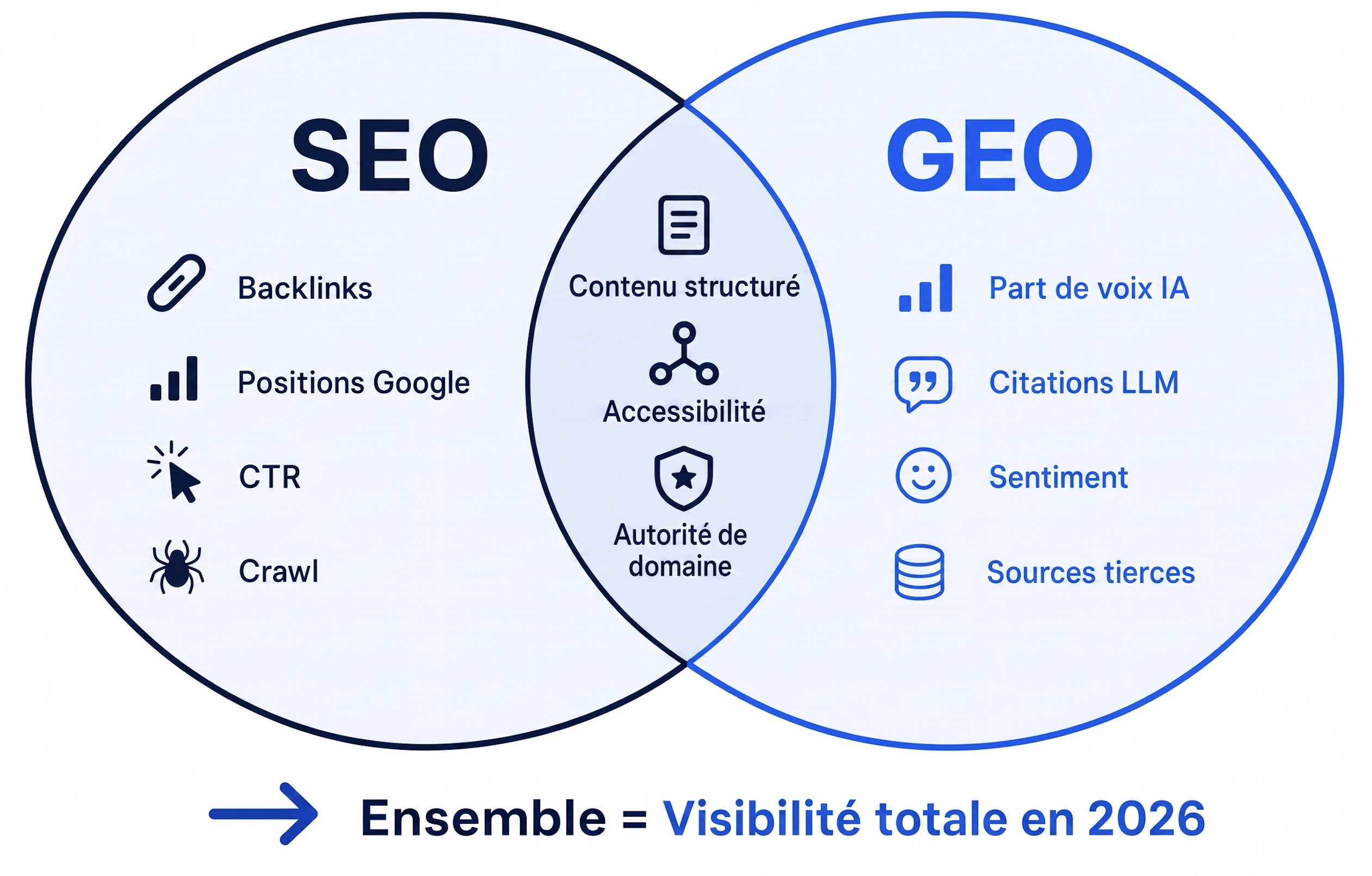
Venn diagram showing the complementarity between classic SEO and GEO (Generative Engine Optimization)

SEO and GEO share a common technical foundation, but each requires its own specific optimisations.

Here is a comparison table to understand how the two approaches work together:

Dimension Classic SEO focus GEO focus (AI optimisation)
Primary goal Drive clicks to the website Be cited as the best answer or solution
Success KPI Average position, organic traffic AI share of voice, citation rate, sentiment
Content format Long articles, repeated keywords Concise Q&A, structured data, clear lists
Importance of third-party sources Medium (to earn backlinks) Critical (AIs synthesise reviews and comparison sites)
Priority technique Page speed, Core Web Vitals Bot accessibility (robots.txt), Schema.org

6 practices that work for both SEO and GEO

The good news is that you do not need to build two separate content strategies. Here are 6 actionable practices that will simultaneously boost your Google rankings and your AI visibility.

1. Unblock access for AI bots

This is the absolute prerequisite. Many sites block OpenAI's crawlers (GPTBot), Anthropic's (ClaudeBot) or Perplexity's by default in their robots.txt file, often out of concern about scraping. If you block these bots, you are preventing yourself from being read and cited by those AIs. Check your technical configuration by reading our robots.txt documentation for GEO.

2. Structure your data with Schema.org

LLMs are probabilistic machines. The easier you make it for them to understand your content, the more likely they are to use it. Implementing Schema.org markup (FAQ, Article, Product, Review) is the best way to pre-digest the work for the AI. A clean HTML table or a well-formatted bullet list will always be preferred over a long, dense paragraph. To go further, read our guide on micro-data and Schema.org markup.

3. Adopt the Question/Answer (Q&A) format

Users ask questions to AIs. The most direct way to capture that traffic is to embed those exact questions in your content. Create autonomous Q&A blocks (between 150 and 300 words) scattered throughout your articles. Each block should contain the precise question (e.g. "How do you measure AI visibility?") and a direct, complete, jargon-free answer. This is the ideal format for an LLM to extract and cite verbatim.

4. Use conversational and precise language

Keyword stuffing is over. AIs understand context and semantics. Use conversational language that sounds natural, but is extremely precise on facts, figures and named entities (brand names, locations, concepts). LLMs have a strong preference for sourced statistics and clear definitions.

5. Add a summary at the top of every page

Always place a "Key takeaway" or "In a nutshell" block at the very beginning of your long articles. During the retrieval phase (RAG), the AI has only a fraction of a second to analyse your page. A dense, information-rich summary significantly increases your chances of being selected as a relevant source.

6. Control your reputation beyond your own site

This is the biggest difference from traditional SEO. To be recommended by ChatGPT or Perplexity, it is not enough for your own website to claim you are the best. The rest of the web needs to say so too. Encourage your customers to leave reviews on Trustpilot or G2, answer questions on Reddit and Quora, and make sure you are featured in comparison articles in your sector. AIs place enormous trust in online consensus.

Which tools to manage your GEO SEO strategy?

What are the best GEO SEO tools in 2026?

In 2026, the best tools for managing a GEO SEO strategy need to combine multi-LLM tracking (ChatGPT, Perplexity, Gemini, Claude) with semantic analysis. BotRank stands out as the most complete platform, offering AI share of voice tracking, sentiment analysis, a GEO technical audit across more than 20 criteria, and a built-in AI agent (Bob) for optimised content creation. Other tools exist on the market, but tend to focus solely on reporting at significantly higher price points.

Measuring the impact of your GEO actions is impossible with classic SEO tools like Google Search Console or Ahrefs. You need a platform capable of querying the various LLMs daily with your strategic prompts (your Fan-Out Queries) to measure your AI visibility rate.

Which GEO software should I choose in 2026?

The choice of a GEO tool depends on your objectives. If you are looking for an affordable all-in-one solution, BotRank is the ideal choice (from €75/month). It not only tracks your visibility across all AI engines, but also identifies the third-party sources (media, forums) that influence LLMs in your market. If you are still weighing your options, you can read our detailed comparison of alternatives on the market to make the best choice for your team.

To go further in understanding the specific performance indicators for artificial intelligence, we recommend reading our guide on the 8 GEO metrics that matter most in 2026.

Ready to audit your AI visibility?

Discover how ChatGPT, Perplexity and Gemini talk about your brand. Try BotRank for free and get your first GEO scan in minutes.

Create a free account