The 5 Best AI Shopping Assistants for Ecommerce in 2026
AI shopping assistants answer product questions and guide shoppers to checkout on your store. We compare Shopify Inbox, Rep AI, Dialog, Gorgias and Insider One.
Getting your products into ChatGPT is not about writing better product descriptions with an AI assistant. It is about making your products show up in the answers ChatGPT gives a shopper who asks for “a cordless vacuum for an apartment with a cat” or “a sturdy carry-on suitcase under $200”. In 2026, ChatGPT has become a product discovery channel in its own right, with a shopping carousel, personalized buying guides and a choice of merchants. The purchase itself ends on your site. This guide explains what ChatGPT reads to pick a product, the five steps to get your catalog in, then the method to measure whether it is working.
Being positioned in ChatGPT means your product appears, with a correct name, an accurate price and a link to a merchant, at the moment a user asks a buying question. Unlike Google, there are no ten blue links. There is one answer, sometimes a carousel of five to ten products, then a choice of merchants for each. A product missing from that answer does not exist for the shopper.
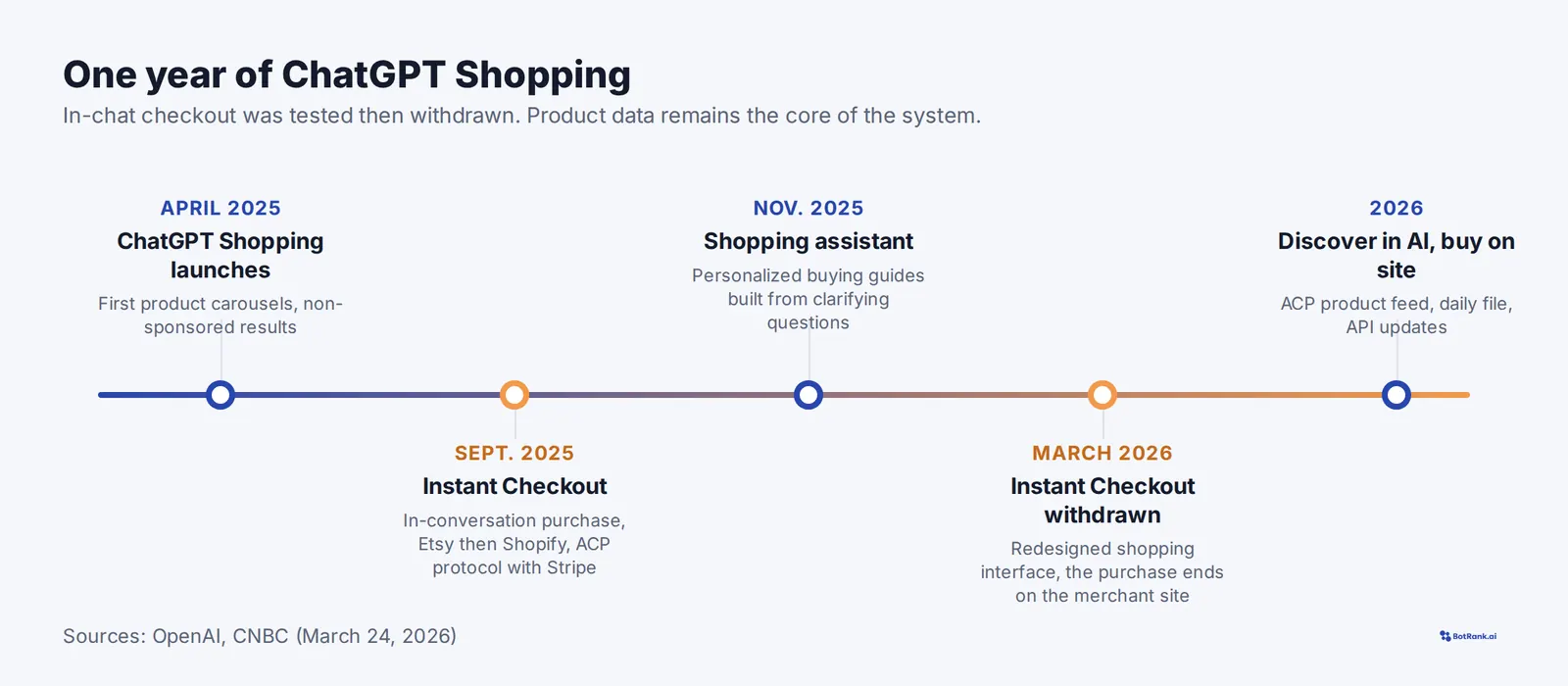
The first surface is the answer text. When ChatGPT recommends “the Rimowa Essential Cabin for its durability”, it relies on what it has read elsewhere: buying guides, comparisons, reviews, forum threads. Your product page is only one source among many, often a minor one. We detailed how this works in what ChatGPT actually reads before it cites your page.
The second surface is the shopping carousel, with image, price, rating and a list of merchants. This layer is fed by structured data: product feeds sent to OpenAI, Shopify catalogs, Schema.org markup on product pages, metadata aggregated by third-party providers. This is where most of the product positioning is decided, because this is where purchase intent is strongest.
The same product can therefore be cited in the text without appearing in the carousel, or the reverse. Winning brands work both layers, with different actions for each.
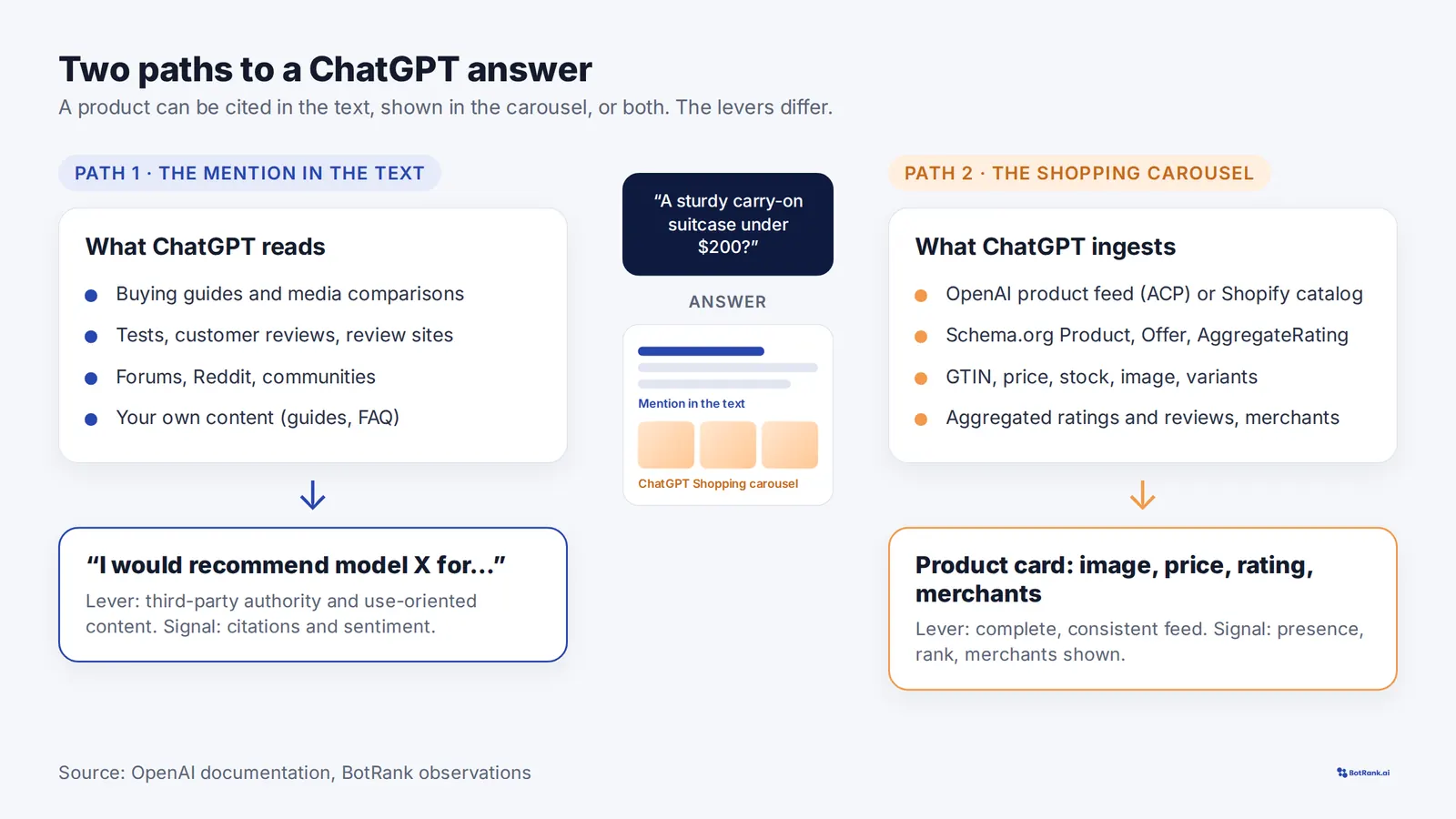
ChatGPT Shopping appeared in late April 2025 with the first product carousels. In September 2025, OpenAI launched Instant Checkout, buying directly inside the conversation, with Etsy then Shopify merchants, built on the Agentic Commerce Protocol developed with Stripe. In November 2025, the shopping assistant (“shopping research”) added personalized buying guides built from clarifying questions.
Then, in March 2026, OpenAI withdrew Instant Checkout. In-chat conversion stayed well below that of the outbound click, while merchants wanted to keep the customer relationship. ChatGPT refocused on discovery: a more visual shopping interface, easier comparisons, then a hand-off to the merchant’s site to pay. We had analyzed this retreat of trust in autonomous checkout in this piece on AI shopping.
The consequence for an online retailer is simple. The model that is settling in is “discover in AI, buy on site”. Your job is not to enable a payment inside ChatGPT. It is to make sure your product gets selected, correctly described, then linked to your own store rather than to a reseller.
No. OpenAI’s documentation is explicit: product results are selected independently by ChatGPT, they are not ads and they are not influenced by OpenAI’s commercial partnerships. Ads, where they exist, are displayed separately from product results. Getting your products into ChatGPT is therefore organic. The real cost is the work on your data and your reputation, not a placement fee.
ChatGPT combines three families of data to build a shopping answer. First, merchant feeds: the product feed sent directly to OpenAI and Shopify catalogs synced automatically. Then, structured metadata retrieved from the web, in particular the Schema.org Product, Offer and AggregateRating markup on your pages, plus data aggregated by third-party providers. Finally, editorial and community sources: buying guides, tests, comparisons, reviews, Reddit threads.
From that data, five signals drive the selection.
SignalWhat ChatGPT looks atWhat you controlIntent relevanceMatch between the product and the question asked, including constraints (budget, use case, context).Titles, descriptions and attributes that describe the use, not only the reference.Structured data qualityCompleteness of the feed and the markup: GTIN, brand, variants, image, rating.Product feed, Schema.org, consistency between the two.Price and availability accuracyDisplayed price identical to the real price, stock up to date.Daily full file, intraday price and stock updates via API, sync with the page.Third-party authorityReviews, tests, guides and discussions that confirm the product’s value.Presence on review sites, relationships with specialist media, communities.Contextual weightingUser memory, custom instructions, budget mentioned in the conversation.Nothing directly, except covering several price ranges and several use cases.
This mechanism explains a frequent observation: a product ranked first on Google Shopping can be absent from ChatGPT. Google ranks ads and pages; ChatGPT selects a small number of products it can describe with confidence. An incomplete feed or a mismatched price is enough to drop out of the selection, whatever the SEO ranking.
Before any optimization, ChatGPT must be able to read your product pages. Three checks are required.
OpenAI uses several bots. OAI-SearchBot feeds search and shopping answers. GPTBot is used for model training. ChatGPT-User corresponds to visits triggered by a user during a conversation. You can allow the first while blocking the second: the two decisions are independent. Check your robots.txt, but also your CDN and firewall rules, where many “anti-AI bot” blocks are enabled by default. We explain why robots.txt is not enough for ChatGPT.
A product page must be indexable, accessible without heavy JavaScript rendering, without a canonical pointing to another variant, without a noindex inherited from a theme. Variant pages (color, size) must be grouped cleanly rather than duplicated. A technical audit oriented toward AI extraction, such as BotRank’s GEO technical audits, detects these defects page by page.
ChatGPT still partly relies on the Bing index for web search. A site missing from Bing Webmaster Tools or poorly indexed on Bing loses part of its retrieval surface. The point is quick to check, it does not require a separate project.
The product feed is the most direct lever for the carousel. OpenAI publishes a feed specification as part of the Agentic Commerce Protocol (ACP), with two methods: uploading a full file, recommended once a day, and an API to update prices, stock and promotions throughout the day. Accepted file formats are JSONL (recommended), CSV, TSV and TXT, optionally gzip-compressed, in UTF-8, with one row per purchasable item or variant.
LevelOpenAI product feed fieldsWhy it mattersRequired (9)item_id, title (max 150 characters), description (max 5,000), url, brand, seller_name, image_url (JPEG or PNG), availability (in_stock, out_of_stock, pre_order, backorder, unknown), price in “amount CURRENCY” formatWithout them, the row is rejected at validation. A missing field is an invisible product.Recommendedgtin, mpn, group_id and variant_dict for variants, sale_price, condition, product_category, color, size, material, dimensions, weight, additional_image_urls, shipping_price, accepts_returns and return_policy, review_count and star_rating, seller_urlIdentifiers let ChatGPT match your product with tests and reviews published elsewhere. Ratings, shipping and returns feed the product card and the comparisons.Eligibility flagsis_eligible_search (true by default), is_eligible_checkout (requires a separate checkout integration), is_ads_eligibleThey decide where the product can appear: organic answers, in-chat checkout, ad formats.
Two flags deserve an explicit decision. is_eligible_search allows the product to appear in answers and carousels. is_eligible_checkout makes it eligible for in-chat payment, which requires an ACP integration with a compatible payment provider. Since the withdrawal of Instant Checkout, the first is enough in the vast majority of cases. The second remains an option for merchants who want to be ready if in-conversation payment comes back in another form. As for is_ads_eligible, it concerns ad formats, which remain distinct from organic product results.
Shopify stores are synced automatically with ChatGPT through Shopify Catalog, with no feed to build. For Adobe Commerce, BigCommerce, PrestaShop and WooCommerce, the simplest path is a feed manager (Lengow, Channable, Feedonomics) that converts your existing Google Shopping feed to the OpenAI specification. If you already have a clean Merchant Center, you already have 80% of the work done.
The feed gets the product in. The product page decides how it is described and whether the displayed price is judged reliable. Four workstreams.
Every product page should expose in JSON-LD a Product object with name, image, description, brand, gtin or mpn, an Offer object with price, priceCurrency, availability and url, then an AggregateRating when you have reviews. For variants, use ProductGroup with hasVariant so ChatGPT understands that a suitcase in blue and the same one in black are a single product.
The GTIN is what lets ChatGPT link your page, the test published by a media outlet and the review left on a marketplace. A product without a GTIN or MPN is an isolated product: the model cannot aggregate the evidence about it. For brands that manufacture their own products, declaring a consistent MPN everywhere (site, feed, marketplaces) plays the same role.
ChatGPT answers questions phrased in terms of use: “for an apartment”, “for an 8-year-old”, “compatible with”. A description that only talks about materials and dimensions does not help the model make that connection. Add a “who it is for, what it is for” section, concrete use cases, compatibilities, honest limits. It is the same principle as ranking a site in ChatGPT Search, applied at product level.
Price and availability accuracy is one of the criteria documented by OpenAI. In practice, if the feed says $189, the page $199 and the JSON-LD $179, the product becomes a potential source of error for the user, which is precisely what ChatGPT is trying to avoid. The same problem arises when an out-of-stock product stays “in stock” in a feed that is only updated once a week. Align the three sources and push your price changes via the API as soon as they happen, without waiting for the daily file upload.
Most of ChatGPT’s citations come from third-party sources, not from brand sites. For buying prompts, comparison guides, tests, review sites and discussion threads do most of the recommendation work. Your product page only has value if other pages confirm what it claims.
Three types of sources matter for a product. Buying guides and tests from specialist media, which give the model its comparative arguments. Review platforms, marketplaces and forums, which bring user validation and often the rating displayed in the product card. Your brand’s own content, when it goes beyond the product page: a “which suitcase for which trip” guide, an honest comparison of your own range, a detailed product FAQ. The full method for the brand layer is in how brands become visible in ChatGPT. BotRank’s Source Analysis shows which domains actually feed the answers in your category, which tells you where to put your effort.
This is the step most guides forget. Without measurement, you will never know whether your feed worked, whether a competitor took your place, or which merchant ChatGPT sends your buyers to.
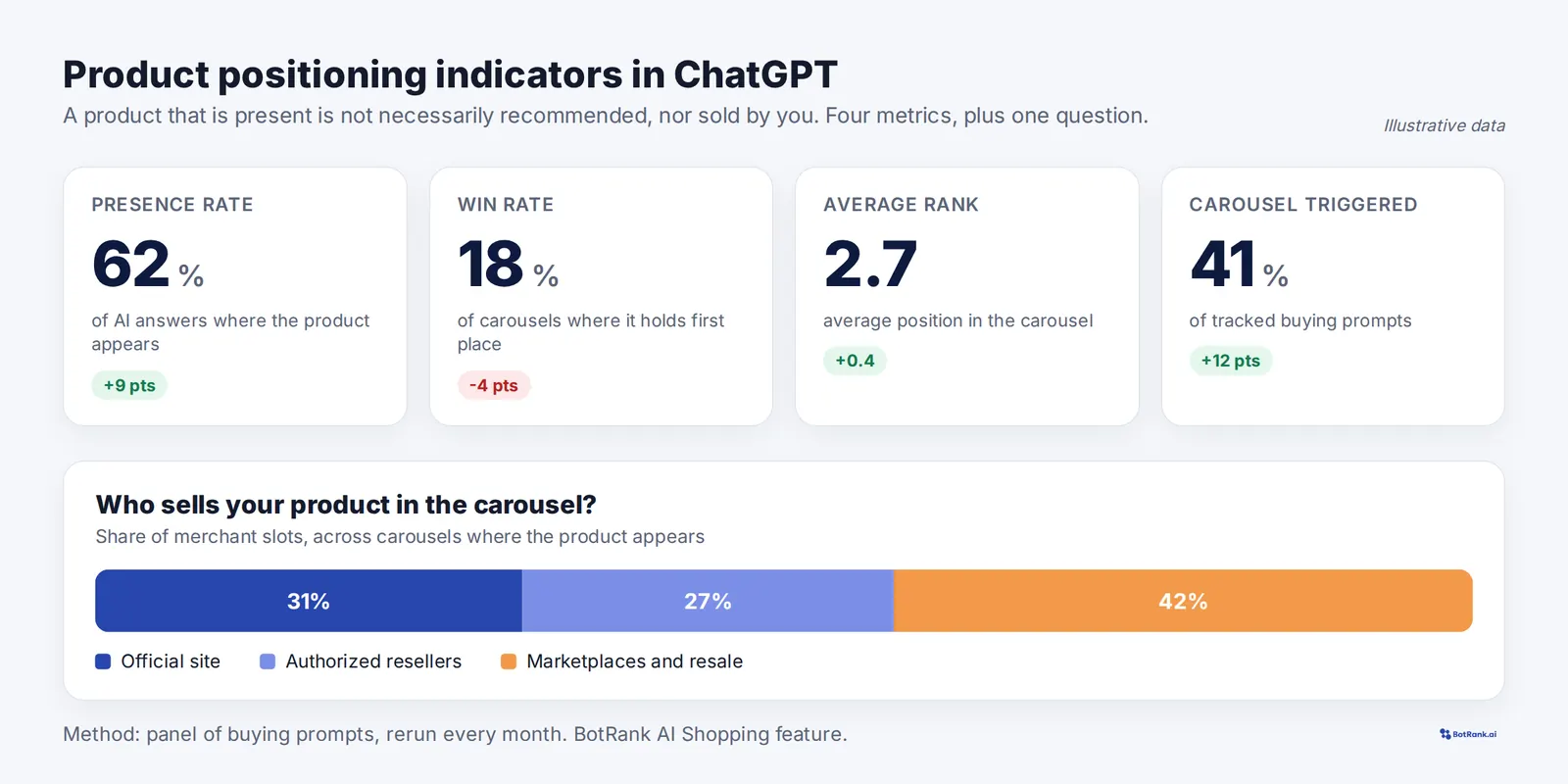
IndicatorDefinitionWhat it revealsPresence rateShare of AI answers where the product appears, across a panel of buying prompts.Whether the product is eligible and selected, or never enters the answer.Win rateShare of carousels where the product holds first place.The real strength of the recommendation, beyond simple presence.Average rankAverage position of the product in the carousel when it appears.The trend over time, notably after a feed change.Carousel trigger rateShare of tracked prompts that produce a shopping carousel.Whether your category is shifting to AI-assisted buying, then how fast.
When ChatGPT shows a product, it offers one or several merchants. Nothing guarantees your site is one of them. On a BotRank demo account tracking a luxury leather goods brand, of 27 products displayed in the carousels, only 4 belonged to the tracked brand. Its own products were pushed through resale and second-hand platforms rather than through its official site. The brand had funded the demand, others collected the sale.
This indicator, the share of product slots that point to your own domain, is the one that speaks most directly to an e-commerce director. It is measured by separating three merchant segments: official site, authorized resellers, marketplaces and resale. This is exactly what BotRank’s AI Shopping feature tracks: presence, win rate, average rank, merchants displayed and observed price range, product by product.
Start with 30 to 100 realistic buying prompts for your category, varying the constraints (budget, use case, context). Rerun them every month, record presence, rank and merchants. This manual method is enough for a first diagnosis. It does not hold over time: answers vary from one session to the next, carousels move faster than text, while a catalog of several hundred references requires automated tracking.
On the traffic side, ChatGPT adds the utm_source=chatgpt.com parameter to outbound links. Create a dedicated view in GA4 to isolate these sessions and measure their conversion rate. Several recent studies place it above that of classic organic traffic, which makes the investment easy to defend.
Most guides on getting products into ChatGPT stop at the feed and the markup. Those two workstreams make a product eligible. They guarantee neither its selection, nor how it is described, nor the merchant the buyer is sent to. Yet that last question decides whether ChatGPT is an acquisition channel for you or for your resellers.
Our conviction is that product positioning in AI should be managed like shelf share in retail: how many slots I occupy, in which position, against whom, then who collects the sale. That is the logic of the AI Shopping feature, designed so that measurement leads to concrete actions on the feed, the product pages and the sources.
Allow OAI-SearchBot, submit a product feed that follows the OpenAI specification (Agentic Commerce Protocol), or let Shopify do it automatically, mark up your product pages with Schema.org Product and Offer including GTIN, align price and stock across all your sources, then build third-party sources (tests, reviews, guides). Then measure the presence of your products across a panel of buying prompts.
No. ChatGPT’s product results are selected independently and are not ads, according to OpenAI’s documentation. Submitting a product feed is free. Ads, where they exist, are displayed separately.
Yes. Product carousels and the shopping assistant have been available in Europe and other markets since their launch. In-conversation payment (Instant Checkout) was limited to the United States and was withdrawn in March 2026.
After a feed is validated, products can appear within a few days. Price and stock updates sent through the API are taken into account within the day. The “third-party sources” layer, however, is built over several months.
All three rely on structured product data. Google uses Merchant Center and the Universal Commerce Protocol, Perplexity has a free merchant program, ChatGPT accepts the OpenAI product feed and the Shopify catalog. A clean feed, with GTINs and accurate prices, serves all three. The third-party sources that matter, however, differ from one engine to another.
Technical SEO remains necessary: indexation, accessibility, structured data. But a good Google ranking does not transfer automatically. ChatGPT selects a small number of products based on data quality and external evidence, not on organic position.

After nearly 15 years in digital strategy on the client side (including 10 years at Olympique Lyonnais, where he was notably in charge of SEO).
Florian co-founded BotRank.ai in 2025, the GEO (Generative Engine Optimization) tool used by more than 2,500 companies to manage their visibility in AI-generated search results. He writes regularly about GEO and AI Search.