The 5 Best AI Shopping Assistants for Ecommerce in 2026
AI shopping assistants answer product questions and guide shoppers to checkout on your store. We compare Shopify Inbox, Rep AI, Dialog, Gorgias and Insider One.
In a nutshell: LLM tracking means measuring your brand's visibility in the answers generated by ChatGPT, Perplexity, Gemini, Claude and other AI engines. Unlike traditional SEO, it is not about tracking positions on Google; it is about knowing whether AI models cite you, how they describe you, and which sources they rely on to talk about you. It is the essential AI visibility audit for any business that wants to stay visible in 2026. To get started right away, create your BotRank account for free and run your first audit in under 10 minutes.
Imagine your best salesperson is absent from every client meeting. That is exactly what happens when your brand does not appear in AI-generated answers. In 2026, millions of people ask their questions to ChatGPT, Perplexity or Gemini instead of Google every single day. They ask: "What is the best GEO tool?", "Which SEO agency would you recommend in London?", "What HR software should I choose for a mid-sized company?". If your brand is not in the answer, it simply does not exist for that user.
The problem is that this AI visibility is completely invisible with traditional tools. Google Search Console will never tell you whether ChatGPT cites you. Semrush does not measure your Share of Model. That is precisely why LLM tracking has become a strategic priority: it gives you a window into a reality that your current tools ignore entirely. If you are new to the topic, our article what is GEO covers the essential foundations.
An AI visibility audit answers three fundamental questions: do AI models know me? Do they recommend me? And above all, how do they describe me? A brand can be cited while being consistently associated with negative terms like "expensive", "complex" or "unreliable". Without tracking, you are navigating blind in one of the most important acquisition channels of the decade.
LLM tracking (Large Language Model tracking) is the practice of automatically and regularly monitoring how generative AI models (ChatGPT, Gemini, Perplexity, Claude...) talk about your brand, your products and your industry. In practice, an LLM tracking tool sends hundreds of questions to different AI engines, analyses their responses, and tells you: how often you are cited, in what context, with what sentiment, and against which competitors.
It is urgent because user behaviour is changing fast. According to Gartner, traditional search engine volume could drop by 25% by 2026 as AI-powered search gains ground. A business that does not measure its AI visibility today is building a strategic gap that will be very hard to close in 12 to 18 months.
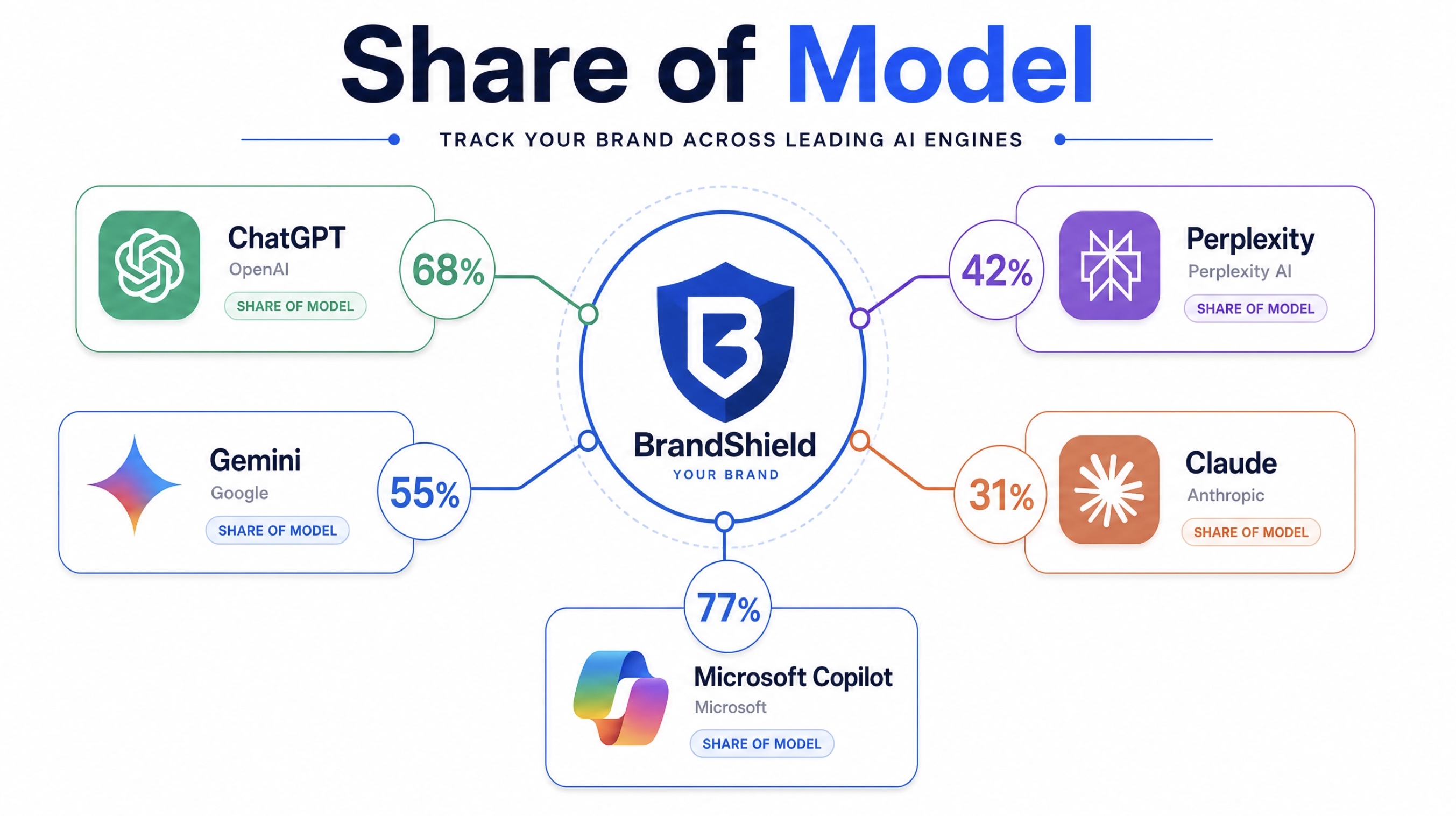
LLMs cross-reference dozens of sources to build each answer: blog articles, Reddit, Wikipedia, Google reviews, press releases...
To understand why LLM tracking is so different from SEO, you first need to understand how AI models construct their answers. It is not a ranking algorithm like Google. It is a synthesis process: the model was trained on billions of texts, and when asked a question, it generates a response based on the patterns it has learned. For tools like Perplexity that perform real-time web retrieval (RAG, or Retrieval-Augmented Generation), there is also a live source-fetching phase on top of that.
What is fascinating is the diversity of sources LLMs draw from. Unlike Google, which focuses primarily on your website, an AI can form its opinion about your brand from:
This is where everything plays out. If Reddit is full of negative comments about your customer service, ChatGPT knows. If no press articles mention you, Perplexity will ignore you in favour of a competitor with better media coverage. Understanding these sourcing mechanisms is the first step of an effective GEO strategy, and it is exactly what a solid AI visibility audit lets you map out.
To go deeper on the technical side, read our documentation on robots.txt and AI bot accessibility: a frequently overlooked prerequisite that can block your indexation by LLMs. Two other essential technical resources: our guide on conversational language and content structuring for AI, and our documentation on micro-data and Schema.org markup to make it easier for LLMs to extract your information.
The popular jury analogy: imagine your reputation is judged not by a single judge (Google), but by a jury of 5 people (ChatGPT, Gemini, Perplexity, Claude, Copilot). Each one has read different things about you, from different sources. One saw your Trustpilot reviews, another read a Reddit thread, a third found your case study. The final verdict depends on everything they collectively read. LLM tracking is the ability to know what each juror has read about you, and to influence that body of evidence.
Here is a very common mistake: only tracking your visibility on ChatGPT. It is a bit like measuring your SEO exclusively on Google.com while ignoring Bing, Yahoo and mobile search. In reality, each LLM has its own biases, its own reference sources and its own behaviour. A brand can be very well positioned on ChatGPT and completely absent from Perplexity, simply because the two tools do not have access to the same real-time data.
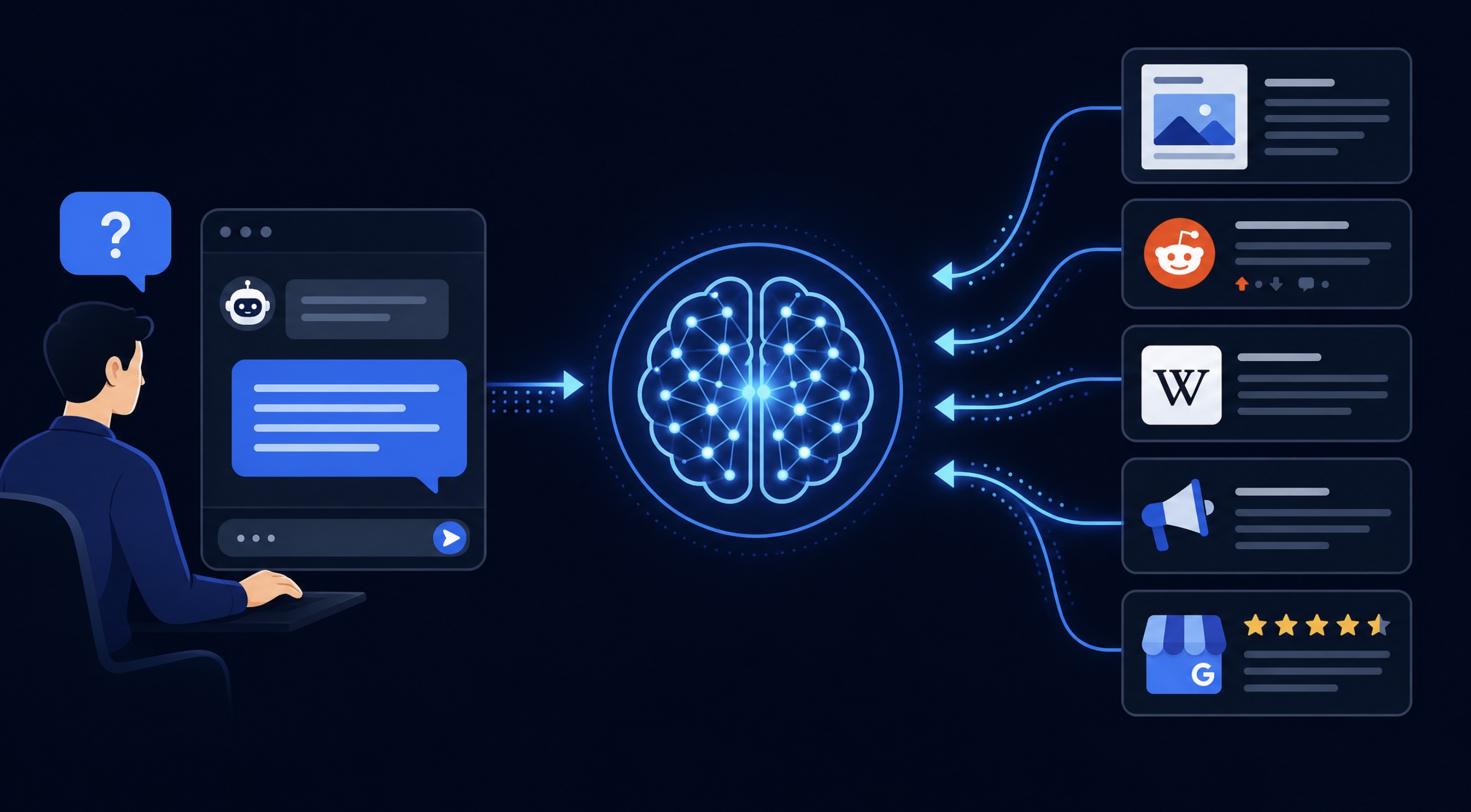
AI share of voice: the central GEO tracking metric, measured simultaneously across all major AI engines
Let's look at a concrete example. Perplexity is an AI search engine that performs real-time web searches before answering. It is therefore highly sensitive to your presence in recent sources: press articles from the last 3 months, new customer reviews, recent LinkedIn posts. ChatGPT (in its version without web browsing), on the other hand, relies more heavily on its training data, which can be several months old. Gemini is natively connected to the Google ecosystem and places particular importance on your presence on Google My Business and high-authority sites indexed by Google.
Multi-engine GEO tracking therefore allows you to:
In 2026, the five LLMs to prioritise are ChatGPT (OpenAI), Perplexity, Gemini (Google), Claude (Anthropic) and Microsoft Copilot. These five tools account for the vast majority of AI queries from both professional and consumer users in Europe and North America.
The priority depends on your industry and target audience. If you are a B2B tech company, Perplexity and Claude are particularly important as they are heavily used by technical profiles and decision-makers. If you are in retail or travel, ChatGPT and Gemini dominate consumer use. For European markets, it is also worth monitoring Mistral AI, which is rapidly gaining market share. BotRank tracks all of these engines from a single interface, saving you from juggling multiple tools. Create a free account to see your brand's performance across all engines at once.
A question that comes up often: "I already have good SEO, do I really need LLM tracking?" The short answer is yes, and here is why. SEO and GEO tracking measure fundamentally different things, with metrics that barely overlap.
| Dimension | Traditional SEO | LLM tracking / GEO |
|---|---|---|
| What is measured | Position on a Google SERP (1 to 100+) | Presence in a generated answer (cited / not cited) |
| Unit of measurement | Rank, organic traffic, CTR | AI share of voice, visibility rate, citation rate, sentiment |
| Sources monitored | Your website only | Your site + Reddit + press + reviews + forums... |
| Update frequency | Daily to weekly | Daily (LLMs evolve continuously) |
| Personalisation | Low (results nearly identical for all users) | High (each LLM generates a unique response) |
| Main lever | Backlinks, on-page content, technical SEO | Structured content, PR, third-party sources, Schema.org |
The good news is that both disciplines reinforce each other. Strong technical SEO (fast site, structured data, well-organised content) makes it easier for AI bots to index your pages. And a solid GEO strategy (presence on trusted third-party sources, Q&A-structured content) also improves your authority in Google's eyes. It is not one or the other; it is both. To explore this complementarity further, read our complete guide on how to do GEO in 2026.
To understand the specific metrics used in GEO, read our guide on the 8 GEO metrics that matter in 2026.
BotRank is an LLM tracking and AI visibility audit platform designed to take you from measurement to action. Here is what it does in practice, every day, for marketing and SEO teams. You can create a free account to test it on your own brand right now.
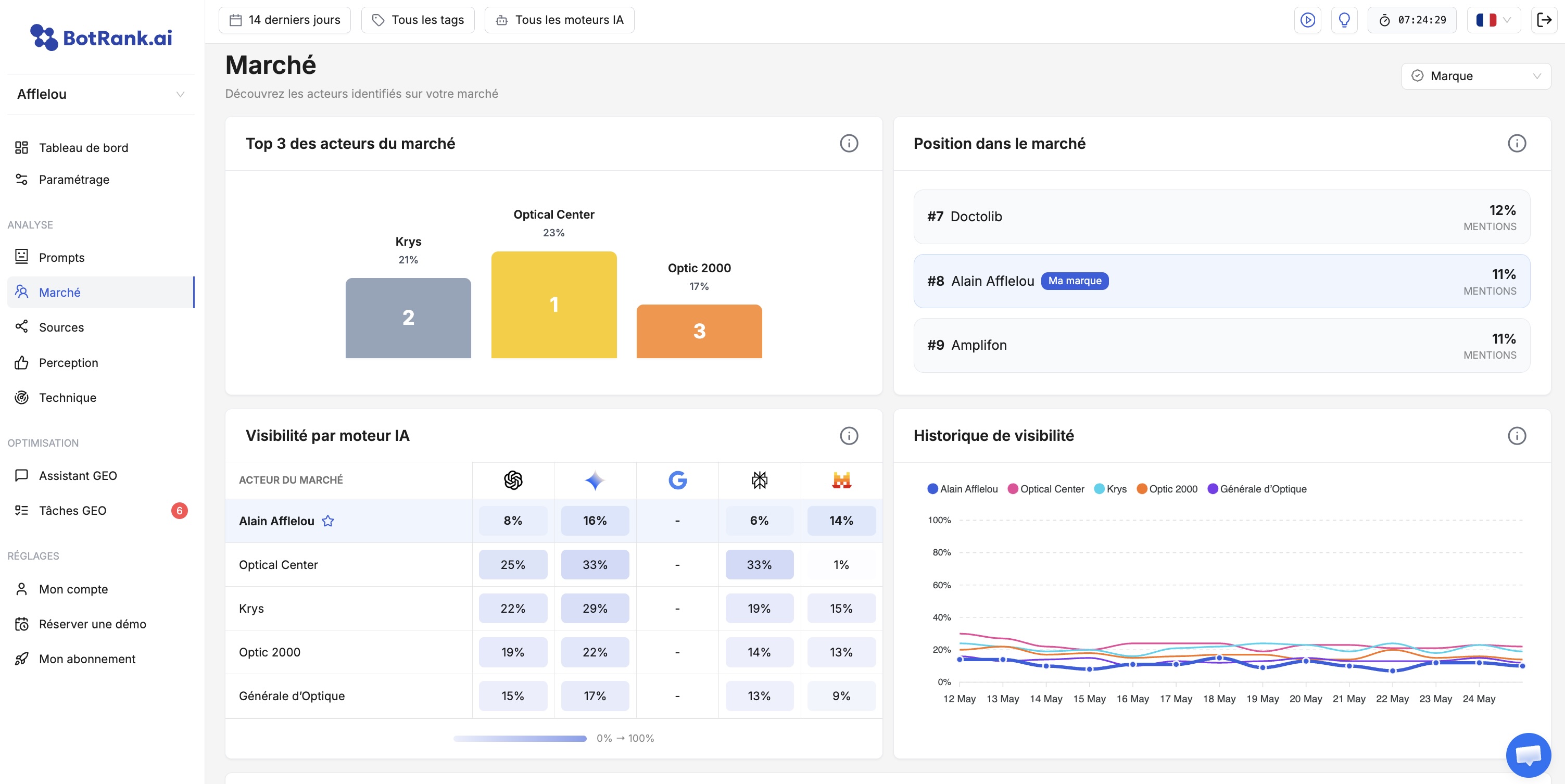
The BotRank platform centralises GEO tracking across all major LLMs from a single dashboard
This is the central metric of LLM tracking. BotRank automatically sends your strategic prompts (the questions your customers ask AI engines) to each model, and calculates your AI visibility rate: the percentage of responses in which your brand appears. If ChatGPT cites you in 68 out of 100 responses but Perplexity only in 31, you know exactly where to focus your GEO optimisation efforts. This AI share of voice is tracked daily, with an evolution curve and a direct comparison against your competitors.
Being cited is good. Being cited positively is better. BotRank analyses the sentiment associated with every mention of your brand in AI responses. If Gemini consistently describes you as "an expensive solution", that is a warning signal that should trigger a concrete PR action: publish content about your value for money, gather authentic customer reviews that highlight value, and get featured on positive comparison sites.
This is one of BotRank's most powerful features. The GEO scan analyses your key pages the way an AI engine would, across more than 20 optimisation criteria organised into four categories: technical, structure, content and authority. Each page receives a score out of 100 and a prioritised list of recommendations, ready to implement.
Among the criteria analysed: accessibility to AI bots (including the configuration of your robots.txt file), the presence and quality of Schema.org structured data, the use of conversational language adapted for AI, the density and relevance of named entities, heading structure, content freshness, and many more. The robots.txt is just one criterion among over twenty: BotRank gives you a complete picture of what is holding back your AI visibility, page by page.
LLM tracking makes most sense when benchmarked against competitors. BotRank shows you, for each prompt, which brands are being cited instead of you and with what share of voice. But the platform goes further: it also identifies the sources AI engines use when talking about your market. Which media outlets, blogs and forums most influence ChatGPT or Perplexity's answers in your sector? This intelligence is invaluable for shaping your PR strategy and content creation priorities.
BotRank includes Bob, an AI agent specialised in GEO that goes far beyond simple measurement. Bob analyses your visibility data, competitors and influential sources in real time, then orchestrates concrete actions: drafting articles and structured content designed to be cited by ChatGPT and Gemini, generating ready-to-use technical code and recommendations, and producing a clear, self-updating action plan. Bob can even create content tailored to specific channels such as Reddit or social media, which are sources LLMs regularly draw from.
BotRank works in three steps. First, you define your "strategic prompts": the questions your target customers ask AI engines (for example "what is the best GEO tracking tool?", "which GEO solution would you recommend for a mid-sized business?"). These prompts are organised by theme and search intent.
Next, BotRank automatically sends these prompts to each configured LLM (ChatGPT, Perplexity, Gemini, Claude, Copilot, Mistral...) at the frequency you choose. Responses are collected, analysed and stored. The tool automatically detects mentions of your brand and competitors, and analyses the sentiment associated with each citation.
Finally, results are presented in a centralised dashboard with trends over time, alerts when a significant visibility drop is detected, and concrete optimisation recommendations generated by the Bob AI agent. You can create your account and start your first audit for free in under 10 minutes. To see concrete results from real clients, check out our case studies.
Good news: you do not need to be a data scientist to run your first AI visibility audit. Here is a four-step method to get started effectively.
Start by listing the 10 to 20 questions your ideal customers ask AI engines to find a solution like yours. Vary the phrasing: direct questions ("what is the best..."), comparative questions ("X or Y?"), advisory questions ("how do I choose..."). These prompts will form the foundation of your LLM tracking. To help you build this list, our article on how to measure your AI visibility offers a structured methodology.
Before optimising, measure. Manually submit your prompts to ChatGPT, Perplexity and Gemini, and note: does your brand appear? In what context? With what sentiment? Which competitors are cited instead? This initial diagnostic will give you a baseline to measure your progress against.
Check that your strategic pages are not blocking AI bots. Read our technical guide on robots.txt to learn how to correctly configure access for LLM crawlers. Also verify that your structured data is properly implemented using our Schema.org micro-data documentation, and that your content uses conversational language adapted for AI. These are often the fastest fixes to implement with the highest immediate impact.
Running this diagnostic manually once is useful. Doing it every week across 5 different LLMs with dozens of prompts is impossible without a dedicated tool. That is where BotRank comes in: the platform automates the entire process and alerts you as soon as a significant change in your AI visibility is detected.
To go further in your strategy, explore our resources: how to measure your AI visibility, how to do GEO and what is GEO.
Find out in minutes how ChatGPT, Perplexity and Gemini talk about your brand. First audit free, no credit card required.
Create my free account
After nearly 15 years in digital strategy on the client side (including 10 years at Olympique Lyonnais, where he was notably in charge of SEO).
Florian co-founded BotRank.ai in 2025, the GEO (Generative Engine Optimization) tool used by more than 2,500 companies to manage their visibility in AI-generated search results. He writes regularly about GEO and AI Search.