
How to Get Cited in Google AI Overviews - The Complete Guide (2026)
RAG pipeline, 6 citation factors, technical optimization and AI share of voice measurement: the complete guide to appearing in Google AI Overviews.
Google AI Overviews are radically transforming online search. With 48% of queries now triggering an AI-generated response, traditional organic visibility is no longer enough. This comprehensive guide details how Google's RAG pipeline works, the real impact on web traffic, and most importantly, the 6 proven citation factors to position your brand in these new snippets. Discover how to structure your content, strengthen your topical authority, and use BotRank to measure and optimize your AI share of voice.
AI Overviews represent Google's biggest evolution since its inception. Deployed globally, they transform the search engine into a true answer engine. Instead of offering a list of blue links, Google synthesizes information from multiple sources to formulate a direct, conversational, and sourced response displayed at the top of the results.
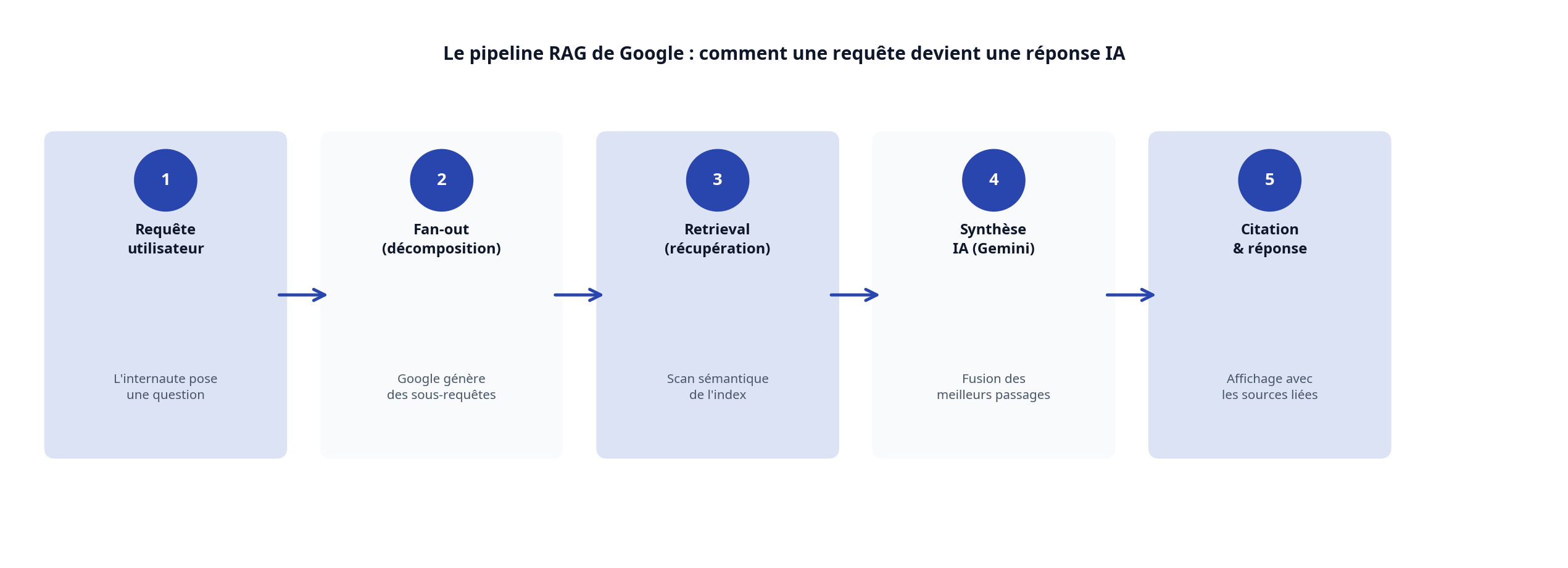
To understand how to get cited, you first need to understand how Google selects its sources. This process relies on an architecture called RAG (Retrieval-Augmented Generation), which unfolds in five distinct steps.
Google's RAG pipeline: how a query becomes a sourced AI response
The first step is query understanding. When a user asks a complex question, the system doesn't just look for simple keyword matches. It analyzes the intent, the entities involved, and the overall context of the search.
The second step, crucial for SEO, is the "fan-out" or decomposition. The model simultaneously generates several associated sub-queries. For a search on "how to care for a bonsai," the system will search in parallel for "bonsai watering frequency," "best bonsai soil," and "common bonsai diseases." This is why you can be cited on a query without even targeting the main keyword, if you perfectly answer one of the sub-questions.
The third step is retrieval. Google scans its index to find the most semantically relevant passages for each sub-query. It favors structured, recent content from authoritative sources.
The fourth step is synthesis. The AI model (Gemini) merges the best selected passages to write a coherent response. It discards superficial or redundant information to keep only the real added value.
Finally, the fifth step is citation. Every generated statement is verified against the index and attached to its original source. Links to these sources are then displayed as clickable cards in the AI Overview.
A classic rich snippet (featured snippet, People Also Ask) extracts a single passage from a single page and displays it as is. An AI Overview is fundamentally different: it synthesizes information from several distinct sources to build an original response, written by Google's Gemini model. This response does not belong to any particular page; it is the product of an intelligent fusion. The cited sources are not necessarily the highest-ranking pages organically, but those whose passages are the clearest, most structured, and most relevant to the sub-questions generated during the fan-out stage. This is why a page in position 5 or 8 can perfectly well be cited in an AI Overview if it answers a specific sub-question in an exemplary manner that higher-ranking pages do not address as directly. This distinction is fundamental to understanding why optimizing for AI Overviews (GEO) requires a different approach from traditional SEO, which focuses on overall ranking rather than the extractable quality of passages.
The arrival of AI Overviews is profoundly changing user behavior and the distribution of organic traffic. Data collected in 2025 and 2026 paints a clear picture of this new reality, which is both concerning for absent brands and highly favorable for those that manage to get cited.
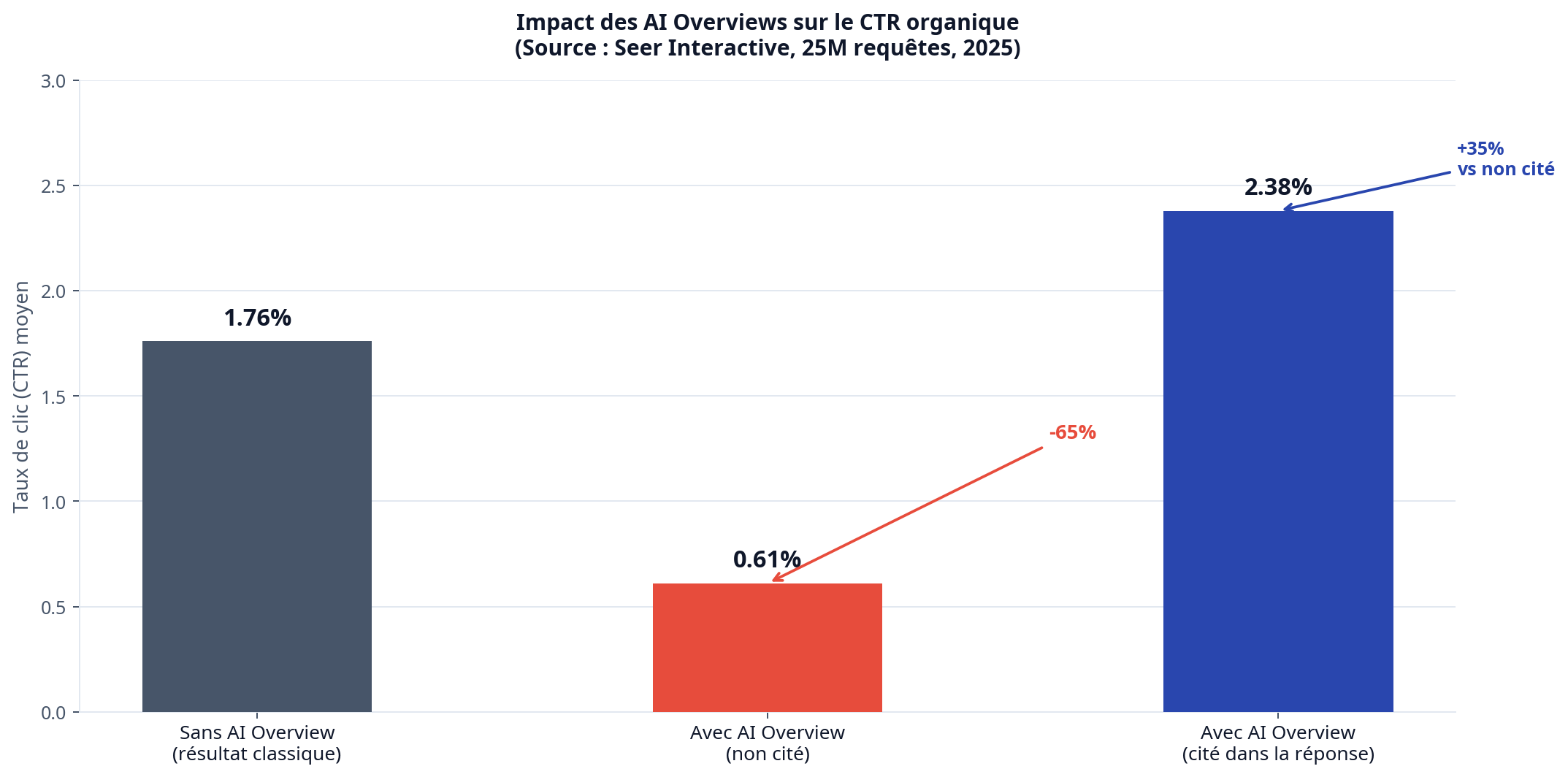
The presence of an AI Overview mechanically reduces the need to click on traditional results. According to a study of 25 million queries conducted by Seer Interactive, the organic click-through rate (CTR) drops by an average of 61% when an AI response is displayed. Pew Research confirms this trend: users only click on a result in 8% of visits when an AI Overview is present, compared to 15% without it. Nearly 60% of Google searches now end without any click to an external website (Semrush, June 2026).
However, this drop is not uniform. Simple informational queries are the most affected. The health, education, and media sectors are seeing their informational traffic heavily impacted. Conversely, transactional e-commerce remains relatively preserved, with AI Overview coverage of only 13 to 14% of queries.
Source: Seer Interactive, study on 25 million queries, 2025
While the overall volume of clicks is decreasing, the value of the remaining clicks is increasing dramatically. Brands cited in AI Overviews enjoy premium visibility that translates directly into business results. Data shows that visitors coming from AI platforms convert significantly better than traditional organic visitors.
A major study by Ahrefs revealed that while AI-driven traffic represented only 0.5% of total volume, it generated 12.1% of signups, a conversion rate 23 times higher. Semrush evaluates the value of an AI visitor at 4.4 times that of a classic organic visitor. These visitors arrive on your site pre-qualified: they have already read the AI synthesis and click to dig deeper or take action.
The algorithm that selects sources for AI Overviews differs from the traditional ranking algorithm. Although both share common foundations, the AI favors specific signals related to clarity, structure, and trust. Here are the 6 determining factors identified by the most recent studies.
Dense, interlinked content clusters on your subject signal to the AI that your domain is an essential reference on this topic.
Named author with verifiable bio, visible publication date, cited external sources, and proprietary data reinforce the AI's trust.
Standalone passages of 130-170 words covering the sub-questions related to the main query, generated during the fan-out stage.
H2/H3 formulated as questions, lists, tables, and FAQPage schema make it easier for the model to extract passages.
Recent date, cited sources, absence of unsourced claims, and green Core Web Vitals reassure the algorithm about the page's quality.
Backlinks from relevant domains, mentions in the specialized press, and presence on YouTube and Reddit contribute to your legitimacy.
No, and this is one of the most important discoveries for SEO teams. Data from seoClarity covering 5.1 million citations shows that 56% of the sources cited in AI Overviews come from the top 20 organic results, including 27% from pages ranked between the 11th and 20th position. Position #1 offers a 33% probability of citation, but position #10 still retains a 13% chance. What matters more than rank is the extractable quality of the passage. A page in position 7 that directly and clearly answers a specific sub-question will be preferred over the page in position 1 that treats the subject generally. That being said, SEO foundations remain essential: 94% of AI Overviews cite at least one URL from the top 20 organic results. You must therefore first aim for a good organic ranking, then optimize the structure and clarity of your passages to maximize the chances of extraction by the AI.
Writing for generative engines (GEO) requires a different approach from traditional SEO. The goal is no longer just to place keywords, but to provide answers ready to be extracted and synthesized. Each section of your content must be able to live independently.
The structure of your content should reflect the user's logic of questioning. Start by identifying the most frequent questions around your main topic. Use these questions as section headings (H2 or H3). This practice, often called "question-based headings," is one of the most effective for capturing AI citations.
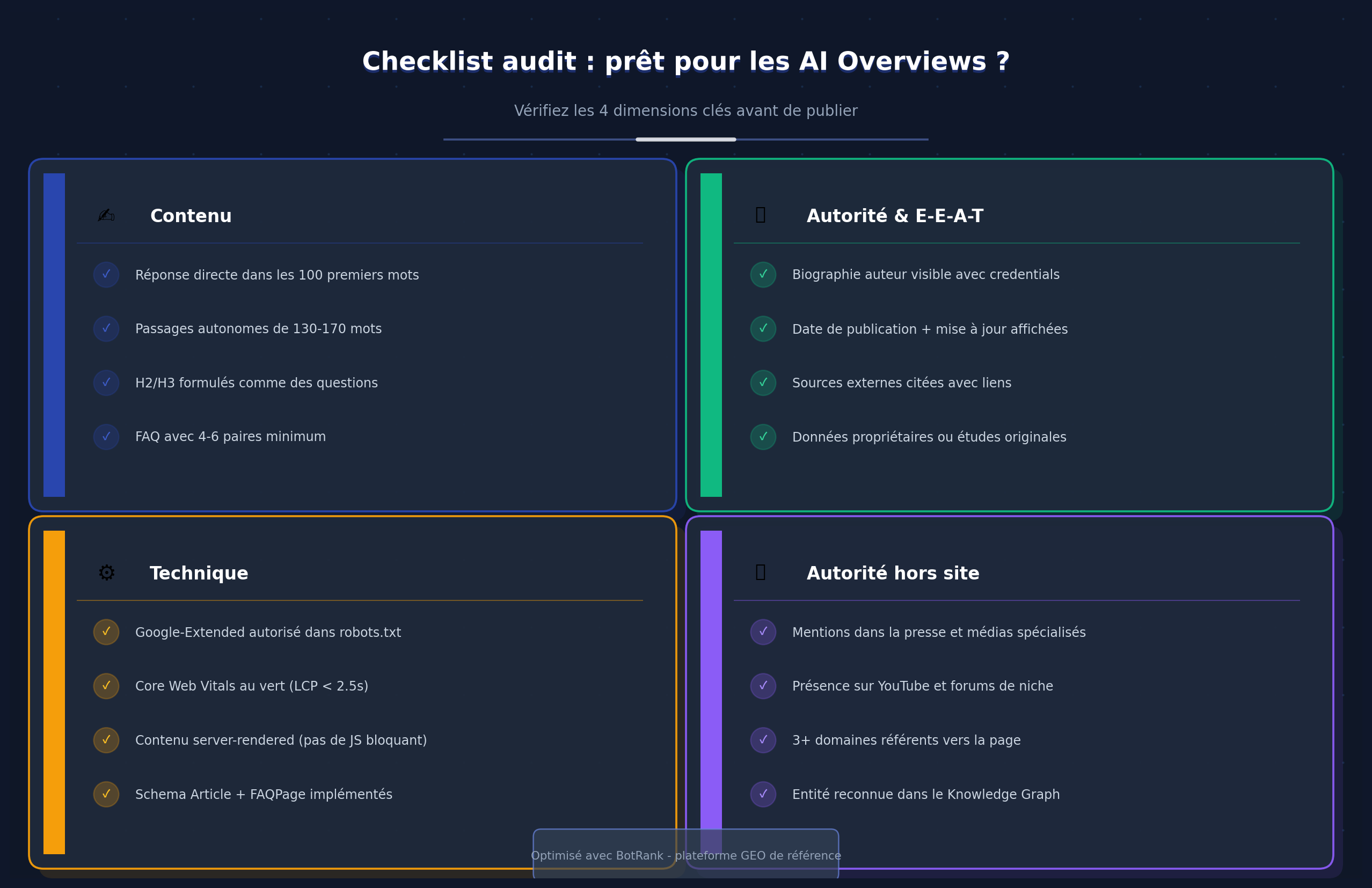
Immediately below each heading, provide a direct, clear, and concise answer. This introductory paragraph, ideally between 130 and 170 words, must be readable on its own. It must contain the essential information, without unnecessary jargon or filler sentences. This is the specific passage the AI is most likely to extract. After this direct answer, you can develop the subject, provide nuances, examples, or numerical data in the following paragraphs.
Integrating an FAQ section at the end of your articles or pillar pages is one of the most effective tactics for capturing AI citations. A well-designed FAQ directly addresses the sub-queries generated by Google's "fan-out." Each question/answer pair must be treated as an independent entity, with complete but synthetic answers (150 to 300 words). Be sure to implement the FAQPage structured data markup to explicitly signal this format to crawlers. Check out our guide on micro-data and schema markup for technical implementation.
AI models are trained on billions of texts. They are perfectly capable of generating generic syntheses. For your content to be cited, it must provide information that the AI cannot invent. Integrate proprietary data, statistics from your own studies, quotes from internal experts, or customer feedback. These unique, verifiable elements grounded in reality will force the AI to cite you as an authoritative source. Avoid paraphrasing existing content; favor a fresh angle and field expertise.
| Content Element | Impact on AI Citation | Practical Recommendation |
|---|---|---|
| Direct answer at the top | Critical | Answer the main question in the first 100 words |
| H2/H3 as questions | High | Formulate as "How to...", "Why...", "What is..." |
| FAQ section with schema | High | Minimum 4-6 Q/A pairs with FAQPage markup |
| Sourced numerical data | Medium-High | Cite the source and date for each statistic |
| Visible update date | Medium | Display the date on the page and in the dateModified schema |
| Internal links to authority pages | Medium | 3 to 5 links to pillar pages on your domain |
Content optimization is not enough if the AI does not consider you a trustworthy source. Strengthening your E-E-A-T signals (Experience, Expertise, Authoritativeness, Trustworthiness) is essential foundational work that pays off over time.
Transparency about the identity of the authors is the first step. Each article must be signed by a real person whose expertise is demonstrable. Create detailed author pages, listing their qualifications, years of experience, previous publications, and links to their professional profiles. Using the Person and Author Schema markup allows you to technically link the content to the author's entity in Google's Knowledge Graph.
Do not scatter your efforts. Focus on creating dense content clusters around your key themes. An exhaustive pillar page, supported by dozens of satellite articles dealing with specific sub-topics, sends a strong signal of topical authority. Ensure rigorous internal linking between these contents. Internal links help bots understand the structure of your expertise and navigate efficiently within your cluster. Check out our guide on conversational language to structure your content optimally for AIs.
AI models do not just analyze your own site to assess your credibility. They take into account your entire digital footprint. Mentions of your brand or your experts in specialized press articles, industry studies, podcasts, or expert forums help build your reputation in the eyes of the algorithms. YouTube is particularly important: it is now the most cited domain in AI Overviews, with a 34% increase in six months according to Ahrefs. Creating well-structured informative videos, with optimized text transcripts, multiplies your touchpoints with AIs. Similarly, an active presence on high-authority niche forums (Reddit, specialized forums) and mentions on Wikipedia, when relevant, reinforce your legitimacy. The goal is to build a recognized entity in the digital ecosystem, not just a well-ranked site. The more your brand is mentioned in varied and credible contexts, the more AIs consider it a reliable source to cite.
Even the best content in the world will not be cited if the AI crawlers cannot access or understand it correctly. Technical foundations are non-negotiable.
This is the most common and costly mistake. Many sites unintentionally block AI-related crawlers via their robots.txt file. To appear in Google AI Overviews, you must absolutely allow the Google-Extended bot. This specific robot is used to collect data intended for generating AI responses. If you block it, your content will be excluded from syntheses, even if it is perfectly indexed by the classic Googlebot.
For maximum visibility across all AI engines (ChatGPT, Claude, Perplexity, Mistral, Grok, Copilot...), it is recommended to also allow their respective bots. Check out our complete guide on configuring robots.txt for LLMs for the exact directives to implement.
User-agent: Googlebot Allow: / User-agent: Google-Extended Allow: / User-agent: OAI-SearchBot Allow: / User-agent: ChatGPT-User Allow: / User-agent: PerplexityBot Allow: / User-agent: ClaudeBot Allow: / User-agent: Twitterbot Allow: /
AI models need to access text content quickly. The technical performance of your site, measured by Core Web Vitals (LCP under 2.5 seconds, CLS under 0.1), remains a selection criterion. More importantly, the majority of AI crawlers do not execute JavaScript as exhaustively as modern browsers. If your main content relies on JavaScript to display, it risks being invisible to the AI. Favor Server-Side Rendering (SSR) to ensure that the text is immediately available in the source HTML code.
Structured data (Schema markup) acts as a direct translator for the AI. It explicitly categorizes information, eliminating any ambiguity. Systematically implement the Article or BlogPosting schema with the datePublished and dateModified fields correctly filled in. Information freshness is a major criterion: 65% of AI bot hits target content published within the year. For tutorials, the HowTo schema is particularly effective for structuring information sequentially.
Exposure to AI Overviews varies considerably by industry. The most affected sectors are those where queries are predominantly informational: health (up to 88% of queries trigger an AI Overview according to BrightEdge), education, media, and B2B/SaaS. For these sectors, the optimization challenge is maximal because almost all informational traffic now passes through AI responses. Conversely, transactional e-commerce is much less exposed, with only 13 to 14% of queries triggering an AI Overview. Searches like "buy [product]" or "price [product]" remain dominated by organic results and Google Shopping ads. However, even e-commerce sites have every interest in optimizing their informational content (buying guides, comparisons, product FAQs) to capture users in the research phase, before they move on to purchase intent. The general rule is simple: the more informational your sector is, the more urgent and strategic optimization for AI Overviews becomes.
Optimizing for AI Overviews is not an exact science; it's an iterative process that requires precise and up-to-date data. Without measurement, it's impossible to know if your efforts are paying off. This is where BotRank comes in as the leading GEO platform.
BotRank offers a complete suite of tools to analyze, understand, and improve your AI share of voice across all models on the market: Google AI Overview, ChatGPT, Gemini, Claude, Perplexity, Mistral, Grok, Copilot, and many others. here is how each feature fits into your optimization strategy.
AI Overviews automatically appear at the top of classic search results for certain queries. AI Mode is a distinct interface, often voluntarily activated by the user, which offers a fully conversational search experience, similar to a chat with a virtual assistant. AI Mode handles more complex, multi-step queries and can remember the context of the conversation. The optimization principles remain broadly the same for both formats: structured content, topical authority, and E-E-A-T signals.
Absolutely not. GEO (Generative Engine Optimization) is an evolution of SEO, not a replacement. As we have seen, 94% of the sources cited by AIs come from pages already well-ranked in the top 20 organically. Technical foundations, domain authority, and content quality remain essential. GEO adds a specific optimization layer to facilitate extraction and synthesis by AI models: passage structure, questions/answers, structured data, content freshness.
There is no guaranteed timeframe. However, observations show that pages implementing best practices (direct answers, clear structure, structured data, updated date) can start being cited within 14 to 30 days following the passage of crawlers. Regular updates and content freshness generally accelerate this process. It should be noted that 40 to 60% of the sources cited in AI Overviews change every month, which means continuous management is essential.
Yes, but rarely on purely transactional queries. On the other hand, they have every chance on informational queries related to their products. Adding detailed buying guides, comparisons, and comprehensive FAQ sections on category pages significantly increases the chances of citation. It is also an excellent way to capture users in the research phase, before they move on to purchase intent.
Google does not currently provide a specific native filter to isolate traffic coming from clicks on AI Overview links in Search Console. This traffic is generally drowned in overall organic traffic. The use of specialized tools like BotRank is essential to measure your real share of voice, track the evolution of your citations on your strategic keywords, analyze the tone of the responses, and compare your performance to that of your competitors across all AI engines.