Why gated content is killing your AI search visibility
Gated content blocks the evidence AI systems need to cite your brand. Learn what to keep public, what to gate, and how to protect leads without losing...
Google Search is no longer evolving around a list of ranked links. It is becoming an AI interface that can understand longer requests, steer users into follow-up questions, generate custom result layouts, and keep watching the web after the search is over. For marketers, the shift is bigger than a new design. It changes where visibility happens.
Links still exist, and Google says AI Mode is not the default. But the product direction is clear. When the search box becomes conversational and the answer page becomes interactive, the first battle is no longer "Can I rank?" It is "Am I present, cited, and useful inside the AI experience?"
Google's new search experience starts with what it calls an "intelligent search box." Instead of nudging people to type short, keyword-style queries, the interface expands for longer requests and suggests more nuanced prompts than classic autocomplete ever could. Users can also continue the session with follow-up questions inside AI Mode, which keeps the search journey inside a conversation.
The bigger change is what happens after the query. Search is starting to generate interactive answer experiences instead of simply returning a page of links. Google described dynamic layouts, custom visuals, and persistent project spaces that users can return to later.
A simple example shows how different this is from old-school search. A question about black holes may no longer lead to a list of articles first. It may lead to a live visual explanation that changes as the user asks new questions in real time.
No. Links are still there. But they are losing their position as the default unit of attention for many searches.
That nuance matters. This is not the end of the web, and it is not proof that ranking no longer matters. It does mean that Google is designing more of the search journey around answers, interfaces, and actions before a click happens. When users are encouraged to ask another question instead of scrolling, ranked results become secondary more often.
For SEO teams, that creates a measurement problem. A page can remain technically indexable and even rank well, while the real user attention moves to an AI answer, a generated widget, or a follow-up flow that never sends the visit.
Information agents turn search from a one-time lookup into ongoing monitoring. Instead of asking the same question every day, users can send an agent to watch for changes and return when something meaningful happens.
Google's example is market monitoring. A user can define specific conditions, let the agent build a monitoring plan, and receive a synthesized update when those conditions are met. That is more than a search result. It is a standing task delegated to AI.
This matters because it changes the timing of discovery. Search used to be pull-based: the user typed, scanned, clicked, and judged sources manually. Agentic search is more subscription-like. The system keeps working in the background, summarizes what changed, and decides when to surface new information. If that becomes normal behavior, brands will need to think not only about being found, but about being selected by the agent as an ongoing source of truth.
The immediate impact is simple: more searches can be completed without a traditional click. That is risky for publishers who depend on referral traffic, and it is equally challenging for brands that still judge performance mainly through sessions, rankings, and last-click attribution.
The longer-term impact is even bigger. Search is starting to behave like a decision layer. It can summarize, compare, visualize, monitor, and increasingly act. That compresses the distance between question and outcome, which is convenient for users but harder on any business model that relied on being one of ten visible links.
There is a practical example hiding in Google's own product demos. If Search can build a meal-planning experience from a user's calendar or generate a fitness workflow around personal goals, the winning content is no longer the page with the best blue-link CTR. It is the source material that an AI system can confidently interpret, reuse, and trust.
BotRank's view is that this is not "SEO is dead" news. It is "visibility has moved upstream" news. Links still matter because AI systems need sources, entities, and pages to draw from. But if the interface increasingly answers first and sends traffic second, ranking reports alone stop telling the full story.
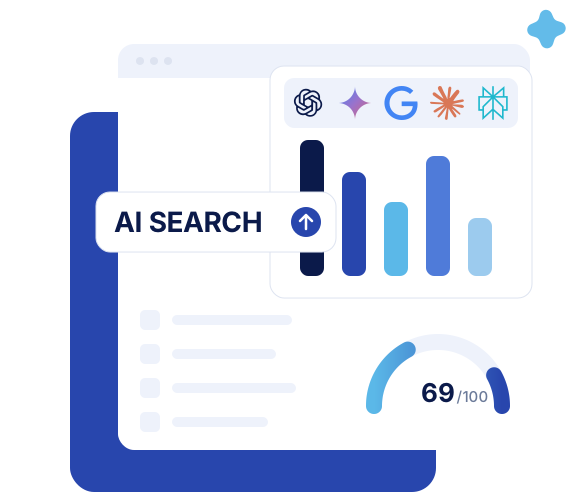
This is exactly where BotRank's AI Visibility feature becomes useful. It lets teams run reusable prompts across major LLMs, track how their brand appears over time, compare visibility by model, and inspect the sources behind those answers. In a search environment shaped by conversations, generated UI, and background agents, that matters more than watching a single SERP position move up or down. The real question is whether your brand is present in the answer, described accurately, and supported by pages the models actually cite.
The teams that adapt fastest will treat AI visibility as a measurable channel, not as a vague side effect of SEO.
No. But it is incomplete on its own.
Google is not removing the open web from Search, and classic results will continue to matter for many tasks. The mistake is assuming the old playbook fully explains the new interface. Technical accessibility, clear site structure, strong topical pages, and credible sourcing still matter because AI systems need dependable material to retrieve and synthesize. What changes is the goal. You are not optimizing only for a click. You are also optimizing for inclusion in the answer layer.
This approach works well for informational and comparative queries, where AI can combine sources into a single response. It may be less dominant in situations where users want a specific site, a niche community, or direct primary-source documentation. That nuance is important. Not every search becomes a chatbot session, but enough of them will to change strategy.
Brands do not need a panic response. They need a clearer measurement and content model.
The big strategic shift is this: winning in AI search is less about occupying a slot and more about becoming the material the system wants to use.
No. Links remain part of Search, but they are not the first focal point in many AI-driven experiences.
It is Google's new AI-oriented entry point for Search. It supports longer, more conversational queries and suggests more complex prompts than standard autocomplete.
They are always-on agents that can monitor the web in the background, track changes against user-defined conditions, and send synthesized updates when something important happens.
They should measure whether they appear in AI answers, how they are described, which pages are being cited, and how that visibility changes across models over time.
Google's new Search direction does not kill SEO. It makes AI visibility impossible to ignore. If your team wants to see how your brand shows up inside AI-generated answers before traffic losses show up in analytics, BotRank gives you a practical place to start.

After nearly 15 years in digital strategy on the client side (including 10 years at Olympique Lyonnais, where he was notably in charge of SEO).
Florian co-founded BotRank.ai in 2025, the GEO (Generative Engine Optimization) tool used by more than 2,500 companies to manage their visibility in AI-generated search results. He writes regularly about GEO and AI Search.