B2B AEO: how to appear in AI answers that shape deals
Learn how B2B AEO helps your brand appear in AI answers used by buying committees. Map prompts by role, strengthen proof, and track visibility.
Summary
Google's AI Overviews and the new AI Mode are radically transforming online search. With a 61% drop in organic click-through rates on affected queries, appearing in these AI-generated snippets is no longer optional; it is a strategic necessity. Unlike traditional SEO, ranking #1 is no longer required to be cited. The algorithm prioritizes semantic completeness, E-E-A-T authority, and data structuring. This article details the differences between AI Overviews and AI Mode, Google's specific ranking factors, and how to use BotRank to measure and optimize your AI share of voice.
The SEO landscape has shifted. In 2026, Google's AI Overviews appear on a massive share of queries, profoundly altering user behavior. But Google did not stop there: the rollout of AI Mode introduces an entirely distinct conversational search experience. Understanding the difference between these two products is the first step in any GEO (Generative Engine Optimization) strategy.
AI Overviews appear automatically at the top of classic search results. They synthesize information for factual or informational queries, citing the sources used. The user has not asked for anything special; the snippet appears on its own. The impact is brutal: organic click-through rates drop by 61% on these queries. However, pages that are cited in this snippet see their clicks increase by 35%.
AI Mode, on the other hand, is an experience the user chooses to activate. Designed for complex, multi-step, and conversational searches, it functions more like ChatGPT or Perplexity. The user can ask follow-up questions, refine their search, and get long, detailed answers. This is where high-consideration purchasing decisions are made.
| Criteria | AI Overviews | AI Mode |
|---|---|---|
| Access | Automatic, no user action required | Voluntarily activated by the user |
| Query type | Informational, factual | Complex, conversational, multi-step |
| Depth | Short summary with citations | Long and detailed answer |
| Follow-up questions | No | Yes, continuous conversation |
| User intent | Quick answer | Deep research, purchasing decision |
| Launch | May 2024 (US) | 2025 (progressive rollout) |
The main difference lies in intent and interaction. The AI Overview is an automatic summary generated at the top of traditional search results to provide a quick answer to a factual question. It cites sources via clickable links. AI Mode is a distinct conversational interface, voluntarily activated by the user for complex, multi-step searches. It allows users to ask follow-up questions and dig deep into a topic without having to formulate new queries. For a brand, the AI Overview generates direct traffic via citations, while AI Mode influences perception and recommendation during in-depth research, particularly for major purchasing decisions.
Traditional SEO is no longer enough. Nearly half of the citations in AI Overviews come from pages that are not ranked in the organic top 5. Google uses a RAG (Retrieval-Augmented Generation) pipeline that looks for the best passage to answer a question, regardless of its initial position in the results. To understand the fundamentals of this approach, check out our guide on measuring AI visibility.
Autonomous and complete answers of 130 to 170 words per passage. Content scoring 8.5/10 on this criterion is 4.2x more likely to be cited.
Text + images + videos + structured data. Pages combining these formats have a 156% higher selection rate than text-only pages.
Recent statistics, cited sources, and verifiable data. This criterion increases the probability of citation by 89%.
Deep semantic match with the query intent. A cosine similarity score above 0.88 generates 7.3x more citations.
Named author with biography, credentials, visible publication date, and external sources cited. 96% of citations come from verifiably authoritative sources.
Use of entities recognized by Google's Knowledge Graph. Pages with 15+ recognized entities are 4.8x more likely to be cited.
Backlinks from relevant domains and brand mentions on credible third-party sources. Less dominant than in classic SEO, but still an essential trust signal.
Ranking first in traditional SEO does not guarantee a citation in the AI Overview because the selection algorithms are fundamentally different. Classic SEO ranks entire pages based on links and keywords. The AI Overview uses a RAG (Retrieval-Augmented Generation) system that extracts specific passages. If your page ranks first but the answer to the user's question is diluted, poorly structured, or buried in a long introduction, the AI will prefer to extract a clear and concise passage from a page ranked in 8th position. To be cited, you must provide direct, autonomous, and semantically complete answers in the first 100 words of your sections. The structure of your content matters as much as its authority.
Optimizing for AI Overviews requires a surgical approach to writing. The golden rule is to reduce friction for the extraction algorithm. Each section of your page must be readable autonomously, without the AI needing the context of previous sections.
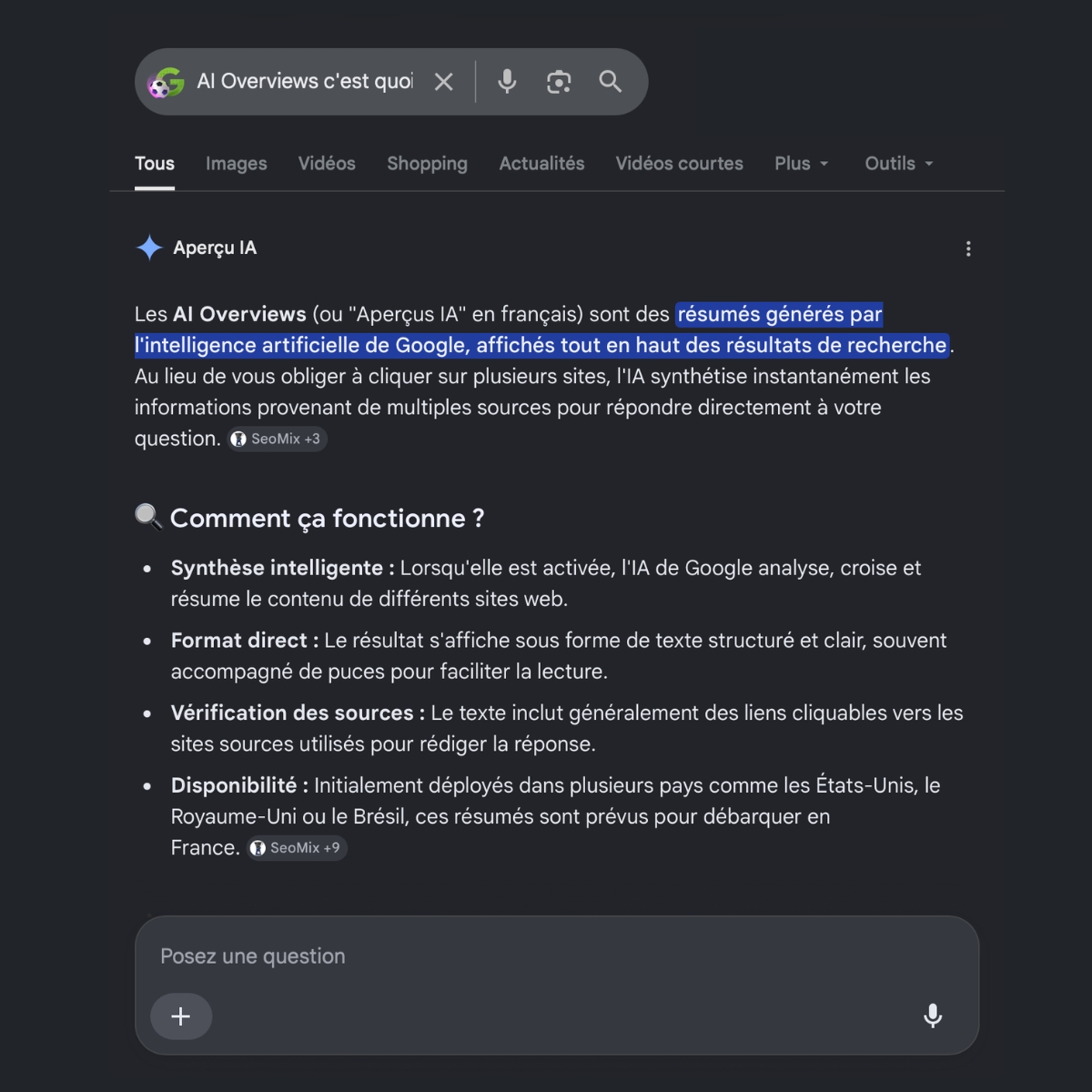
Example of a Google AI Overview: the summary appears at the top of the results with links to the cited sources.
AI Mode requires a different approach. Since it is a conversational interface used for in-depth research, optimization by isolated keywords does not work. The challenge is to build a thematic presence dense enough to feed a multi-layered conversation.
The first priority is to build deep topical authority. Instead of creating ten short articles on variations of the same keyword, you must create exhaustive content hubs that address a topic from all angles. AI Mode will draw from this depth to feed the user's follow-up questions. A complete guide on your industry is better than twenty superficial articles.
Adopt conversational language in your content. Write as you would explain the concept to an expert during a discussion. Anticipate follow-up questions. If you explain a feature, immediately explain its limitations, its cost, and its alternatives, because these will be the next questions asked to AI Mode.
Brand perception plays a crucial role in AI Mode. The latter synthesizes the general opinion of the web on your products. Press relations, mentions on specialized forums, and customer reviews directly feed AI Mode's recommendations during comparison queries. Coordinated GEO and PR work is essential.
No, it is not necessary to create LLMS.txt files or use specific Markdown markup to appear in Google's AI Overviews or AI Mode. Google's official documentation clearly states that its systems do not use these special files for ranking or extraction. Google relies on its classic crawl infrastructure (Googlebot) and standard semantic HTML. While LLMS.txt files can be useful for other AI models like ChatGPT or Perplexity, they have no impact on your visibility in the Google ecosystem. Focus your efforts on content quality, HTML structure, E-E-A-T signals, and the accessibility of your pages to Googlebot.
Navigating this new era of generative search requires adapted tools. Traditional SEO platforms are blind to AI Overviews and AI Mode. BotRank is the GEO platform designed to measure, analyze, and improve your visibility across the entire AI ecosystem, including Google products.
Our Custom offer integrates precise tracking of your visibility on Google's AI Overviews and AI Mode, as well as on Gemini, ChatGPT, Claude, Perplexity, and many others. You know exactly when you are cited, on which query, and with what associated sentiment. The AI visibility tracking module daily analyzes your mentions and calculates your AI share of voice against your competitors.
To take action, BotRank's GEO Scan audits your strategic pages on more than 20 criteria specific to AI extraction: semantic structure, entity clarity, trust signals, technical accessibility. It identifies concrete blocking points and generates prioritized recommendations. Bob, our integrated GEO agent, goes further by writing structured content to maximize your chances of being extracted by Google's RAG algorithms, and by proposing directly implementable technical corrections.
The analysis of influential sources identifies which media, blogs, and forums feed Google AI's answers in your sector. This data is invaluable for targeting your PR efforts where the impact on your AI visibility will be strongest. Our teams support clients with regular check-ins to adjust the strategy according to the rapid evolutions of the Google algorithm.
Join the 2,000+ companies using BotRank to drive their AI share of voice and optimize their presence in Google answers.
Get started for freeAbsolutely not. Optimizing for generative engines (GEO) and classic SEO are synergistic. The actions required to appear in AI Overviews, such as improving page structure, semantic clarification, strengthening E-E-A-T signals, and technical optimization, are exactly the same signals that Google's classic algorithm values. Content well-structured for AI extraction will also be rewarded in traditional organic results. The only difference is that GEO requires extra rigor in the direct formulation of answers and information density.
Measuring the exact traffic coming from AI Overviews remains a technical challenge because Google Search Console does not yet specifically filter these clicks. However, you can isolate the impact by cross-referencing data. Use a GEO platform like BotRank to identify the exact queries where your brand is cited in an AI Overview. Then compare the variations in CTR on these specific queries in your analytics tool before and after the citation appeared. A sudden increase in CTR on a stable organic position is a strong indicator of traffic generated by the AI Overview.
AI Overviews transform traffic; they do not kill it uniformly. Blogs that produce superficial content or simple answers ("commodity" content) will see their traffic collapse, as the AI will answer the user directly. On the other hand, blogs that offer expert analyses, unique feedback, proprietary data, and strong opinions will continue to attract readers. Moreover, being cited as a source in an AI Overview generates highly qualified traffic, because the user clicks to dig deeper into a topic they have already started exploring via the AI's summary.
Studies on AI Overviews show that passages of 130 to 170 words are the most frequently extracted. This length corresponds to what researchers call an "autonomous semantic unit": short enough to be integrated into a summary, long enough to be complete and informative. To optimize your chances, structure each section of your article around a specific question, answer directly in the first few lines, then develop with details and concrete examples. Avoid passages that are too short (less than 80 words) which lack context, and passages that are too long (more than 300 words) which dilute the main information.

After nearly 15 years in digital strategy on the client side (including 10 years at Olympique Lyonnais, where he was notably in charge of SEO).
Florian co-founded BotRank.ai in 2025, the GEO (Generative Engine Optimization) tool used by more than 2,500 companies to manage their visibility in AI-generated search results. He writes regularly about GEO and AI Search.